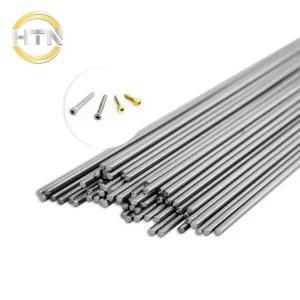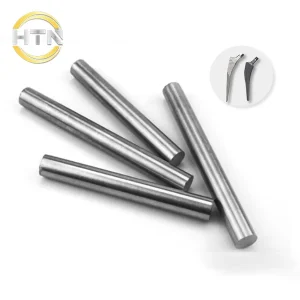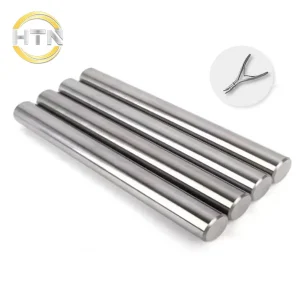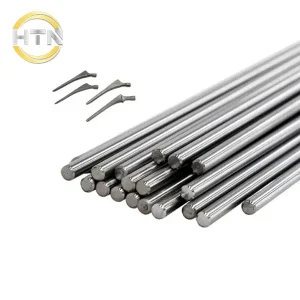






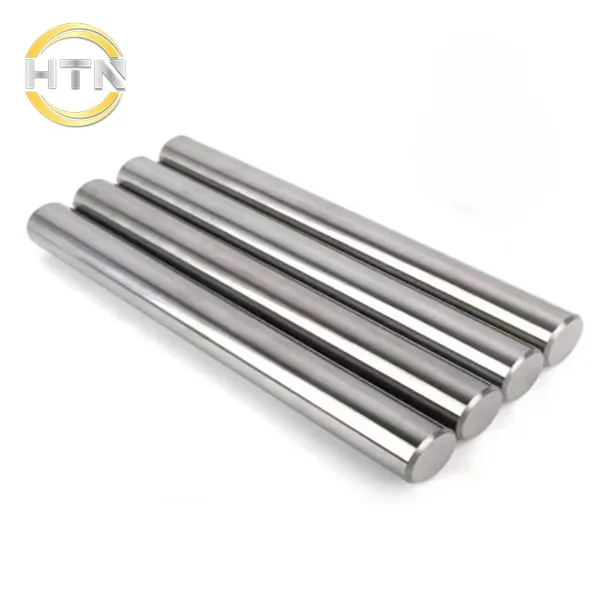
Titanstange / -stab nach ASTM B348 Güteklasse 7
- Standard: ASTM B348
- Grad: Grade 7
- UNS: R52400
- Zustand: Geglüht
- Dia: φ7 ~ φ300 mm
- Typische Länge von Industriestangen: 200–3000 mm
Anpassbare Größen sind verfügbar, die genauen Produktparameter sollten jedoch gemäß der jeweils geltenden Standardausgabe und Bestellung bestätigt werden.
Produktübersicht
ASTM B348 Grade 7 titanium rod/bar is a palladium-bearing commercially pure titanium bar produced and tested to ASTM B348/B348M. The alloy is UNS R52400 and is essentially Grade 2 titanium with 0.12% to 0.25% palladium. It has a typical alpha-phase microstructure. Palladium materially improves corrosion stability in reducing acids, chloride-bearing brines and oxygen-starved crevices.
Compared with Grade 2, Grade 7 has broadly similar strength, weldability and fabrication characteristics, while offering a higher margin against corrosion in reducing media, crevice corrosion and pitting. It is normally supplied annealed. Grade 7 is not selected for Grade-5-style solution-and-aging strengthening; its value lies in long-term corrosion reliability, weldability and heat/lot traceability.
Grade 7 bar is suitable for chemical-process reactors and internals, heat-exchanger components, pumps, valves, flanges, fasteners, seawater and brine-system hardware, hydrometallurgical equipment, flue-gas-desulfurization and pollution-control equipment, and other corrosion-critical machined components.
| Spezifikation | Details |
| Industriestandard | ASTM B348 |
| Industriequalitäten | Gr7 |
| Durchmesserbereich | Ø7 – Ø300 mm |
| Typische Durchmesser | Ø 7, 8, 10, 12, 14, 16, 18, 20, 25, 30, 35, 40, 45, 50, 60, 70, 80, 90, 100, 120, 150, 200 mm |
| Typische Länge von Industriestangen | 200–3000 mm; Zuschnitt auf Wunschlänge möglich |
| Oberflächen-/Versorgungszustand | Warmgewalzte schwarze Oberfläche / gedreht / geschliffen |
| Präzisionstoleranz | h6 / h7 / h8 sind abhängig von Durchmesser, Oberflächenbearbeitung und Auftragsbestätigung erhältlich. |
Hauptmerkmale
- Ausgezeichnete Korrosionsbeständigkeit: Palladium improves repassivation behavior in reducing and crevice conditions. Grade 7 generally offers better corrosion resistance than Grade 2 in many acidic, chloride-bearing and seawater environments.
- Grade-2-like strength and formability: Annealed ASTM minimum tensile strength is 345 MPa, minimum 0.2% offset yield strength is 275 MPa and minimum elongation is 20%.
- Gute Schweißbarkeit: TIG, MIG, plasma, laser and electron-beam welding may be used with complete high-purity inert-gas shielding.
- Good cold and hot workability: The alloy can be forged, hot rolled, drawn, turned, milled, drilled, ground, bent and stamped. Complex cold forming must be qualified for bend radius, surface condition and intermediate annealing.
- Niedrige Dichte und im Wesentlichen nichtmagnetisches Verhalten: Die Dichte beträgt etwa 4,51 g/cm³, was die Herstellung korrosionsbeständiger Leichtbaugeräte und einiger Anwendungen mit magnetischer Empfindlichkeit ermöglicht.
- Not principally heat-treat strengthened: Grade 7 is an alpha titanium alloy. Annealing stabilizes microstructure, relieves stress and supports fabrication; it should not be represented as solution-and-aging strengthened like alpha-beta Grade 5.
Chemische Zusammensetzung
ASTM B348 Grade 7 chemistry is controlled to the following mass-percent limits:
| Element | ASTM B348 Grade 7 requirement |
| Stickstoff, N | ≤0,030% |
| Kohlenstoff, C | ≤0,080% |
| Wasserstoff, H | ≤0,015% |
| Eisen, Fe | ≤0,300% |
| Sauerstoff, O | ≤0,250% |
| Palladium, Pd | 0.12%–0.25% |
| Restelemente, jeweils | ≤0,100% |
| Restelemente, insgesamt | ≤0,400% |
| Titan, Ti | Gleichgewicht |
- Palladium is the defining alloying element in Grade 7. Its controlled addition supports corrosion performance in designated reducing and local-corrosion environments.
- Oxygen, nitrogen, carbon, hydrogen and iron must be controlled. Oxygen, nitrogen and carbon can increase strength while reducing ductility; excessive hydrogen can form brittle hydrides and raise embrittlement risk.
- Final chemistry shall be confirmed by the original mill test report for the applicable heat. Any more-stringent drawing, NACE, ASME, ASTM B265/B861 or customer requirement must be stated in the order.
Mechanische Anforderungen
The following room-temperature tensile requirements apply to annealed ASTM B348 Grade 7 bar. The specified edition, dimensions, specimen form and test orientation must also be considered for formal acceptance.
| Eigentum | Erfordernis | Status |
| Zugfestigkeit, Rm | ≥345 MPa | ASTM-Mindeststandard |
| 0,2% Offset-Streckgrenze, Rp0,2 | ≥275 MPa | ASTM-Mindeststandard |
| Dehnung in der angegebenen Messlänge | ≥20% | ASTM-Mindeststandard |
| Flächenverringerung, Z | ≥30% | ASTM-Mindeststandard |
Typische Eigenschaften bei Raumtemperatur (nicht garantiert)
| Eigentum | Referenzwert |
| Zugfestigkeit | Approx. 345–480 MPa |
| 0,2% Offset-Streckgrenze | Approx. 275–410 MPa |
| Verlängerung | Approx. 20–30% |
| Flächenreduzierung | Generally not less than 30% |
| Elastizitätsmodul | Approx. 102–105 GPa |
Wichtig: Typical values are not ASTM acceptance values and are not automatically guaranteed for every lot. Hardness, UT, PMI, microstructure, corrosion testing, NACE or other tests must be ordered when required.
HTN Supply and Quality Services
ASTM B348 Grade 7 titanium bar is produced by evaluated, qualified mill resources. HTN confirms technical requirements from customer drawings and purchase specifications, selects a mill with appropriate capability, reviews the original MTR and heat/lot records, and verifies the relationship among material standard, dimensions, quantity, condition and inspection documents.
Sofern im Vertrag vereinbart, kann HTN unabhängige Nachprüfungen, Ultraschallprüfungen, PMI, Ablängen, Drehen oder Schleifen, EN 10204 3.1 Dokumentation und Inspektionen durch Dritte sowie Exportverpackung, Versanddokumente und internationale Lieferung koordinieren.
Typische Anwendungen
- Chemical-process reactors, vessels, agitators, tower internals and corrosion-resistant machined components;
- Heat exchangers, condensers, evaporators, seawater and brine heat-transfer-system components;
- Pump shafts, valve stems, valves, flanges, fasteners and pressure-equipment parts;
- Desalination, marine engineering, shipboard, hydrometallurgical and energy equipment;
- Flue-gas desulfurization, pollution control, pulp bleaching and other chloride-bearing or acidic wet-process systems;
- Custom engineering parts requiring weldability, low weight and a high margin against localized corrosion.
Füllen Sie das untenstehende Formular aus, und unser Team hilft Ihnen gerne weiter.
Herstellungs- und Verarbeitungseigenschaften
Bearbeitung
Grade 7 can be turned, milled, drilled, ground and threaded. Titanium’s relatively low thermal conductivity, elastic recovery and tendency to gall call for sharp rigid tooling, stable feed, appropriate cutting speed and abundant non-chlorinated cutting fluid. Dwell and rubbing should be avoided.
Kaltumformung
Its room-temperature forming latitude is generally close to Grade 2 and it can be bent, stamped, drawn and spun. Complex or tight-radius shapes should be validated by trial or qualified procedure, using staged forming, intermediate annealing or warm forming when needed.
Hot working and annealing
Hot forging, rolling, extrusion and drawing can be used to produce bar. Working temperature, reduction, soak time, cooling path and atmosphere must follow a qualified process to limit grain coarsening, oxidation and alpha case. Annealing stabilizes microstructure and properties; Grade 7 should not be claimed to gain alpha-beta-alloy-like strengthening through solution treatment and aging.
Schweißen
Grade 7 has good weldability. The weld pool, face, root and hot heat-affected zone require complete high-purity inert-gas shielding. Critical weldments should be qualified for joint strength, ductility, corrosion behavior and any required post-weld treatment.
Maschinensicherheit: Feine Titanspäne und -pulver sind brennbar und müssen gemäß den geltenden Sicherheitsbestimmungen fern von Zündquellen gesammelt, gelagert und gehandhabt werden.
Typische physikalische Eigenschaften
Nachfolgend sind typische Referenzwerte nahe Raumtemperatur angegeben, die keine zwingenden Annahmekriterien gemäß ASTM B348 darstellen:
| Physikalische Eigenschaften | Typischer Wert |
| Dichte | Ca. 4,51 g/cm³ |
| Elastizitätsmodul | Approx. 102–105 GPa |
| Spezifische Wärmekapazität bei Raumtemperatur | ca. 0,52 J/(g·K) |
| Wärmeleitfähigkeit | Approx. 16–17 W/(m·K) |
| Elektrischer Widerstand | Ca. 0,55 μΩ·m |
| Mittlerer CTE, 20–100 °C | Approx. 8.8×10⁻⁶/K |
| Beta transus | Approx. 900–930°C |
| Schmelztemperatur | Ca. 1660–1670 °C |
| Poisson-Verhältnis | Ca. 0,34 |
| Magnetismus | Im Allgemeinen als nichtmagnetisch angesehen |
Physical-property references: ATI Grade 7, related Grade 7 technical data and industry public data. Values vary with temperature, heat, orientation, section size and annealed condition.
Korrosionsbeständigkeit
Grade 7 corrosion resistance is based on a continuous, tightly adherent titanium-oxide passive film. Palladium improves titanium’s electrochemical behavior in certain reducing-acid, chloride-brine and crevice conditions, giving Grade 7 a higher local-corrosion margin than Grade 2. Actual material selection must still be verified against medium, temperature, concentration, oxygen availability, flow and crevice conditions.
Umgebungen, in denen die 7. Klasse im Allgemeinen gute Leistungen erbringt
- Natürliches Meerwasser, Meeresatmosphären, Salzsprühnebel, Sole und viele chloridreiche wässrige Medien;
- many neutral aqueous solutions, general industrial water, desalination and heat-transfer service where applicable;
- Salpetersäure und viele oxidierende saure Umgebungen;
- evaluated dilute-to-moderate reducing-acid duties, including some sulfuric, hydrochloric or phosphoric acid conditions;
- wet-process metallurgy, chemical processing, pollution control, wet chlorine and other systems demanding improved crevice-corrosion resistance.
Umgebungen, die eine sorgfältige Bewertung erfordern
- fluoridhaltige Medien oder Fluorwasserstoffsäure;
- Hot, concentrated, oxygen-starved or strongly corrosive acids containing reducing metal ions;
- Completely dry chlorine, anhydrous methanol or halide-contaminated methanol;
- Red fuming nitric acid, molten chloride salts, liquid mercury, cadmium and other special chemical environments;
- Pickling, cathodic protection or electrochemical conditions that may promote hydrogen pickup;
- Hot crevices, deposits, dissimilar-metal contact and stressed locations.
Technischer Hinweis: Palladium improves the corrosion margin but does not make Grade 7 universally suitable for all acids, halides or oxygen-starved media. Product literature cannot replace actual-service corrosion testing and engineering review.
Typical Industry Manufacturing Route for Grade 7 Titanium Rod
- Raw-material and alloying preparation: Select qualified titanium sponge, palladium addition materials and approved clean revert, while controlling oxygen, nitrogen, carbon, hydrogen, iron and foreign contamination.
- Elektrodenpräparation: Compact the charge into electrode blocks and assemble the melting electrode, ensuring uniform palladium distribution and exclusion of oil, moisture and iron-bearing foreign matter.
- Vakuumschmelzen und Barrenherstellung: Use VAR, electron-beam cold-hearth melting or another approved titanium melting route. The melting route and number of melts follow the qualified mill process and purchase requirements.
- Konditionierung und chemische Eigenschaften des Rohlings: Nach Bedarf ernten, schälen oder mahlen, die erforderlichen chemischen Analysen durchführen, die Wärmekennzeichnung beibehalten und die notwendigen internen Qualitätskontrollen durchführen.
- Schmiedeprozess im Detail: Upset, draw or multi-directionally forge to break down the cast structure, improve internal uniformity and produce billet for further working.
- Alpha/near-beta hot working and bar formation: Forge, hot roll, extrude, draw or combine processes to produce the required section, controlling temperature, reduction and cooling path for a stable alpha microstructure.
- Glühen: Anneal under a qualified procedure to stabilize microstructure, relieve stress and obtain the required strength-ductility balance.
- Surface conditioning, straightening and finishing: Turn, grind, blast, pickle, straighten, cut, chamfer or polish as required. Pickling must limit hydrogen pickup and meet surface-quality requirements.
- Final inspection, documentation and delivery: Verify chemistry, tensile properties, dimensions, tolerances, surface and identification. UT, PMI, microstructure, hardness, corrosion tests or third-party inspection are performed when ordered. Maintain full correlation among material, labels, heat, lot, condition and original MTR.