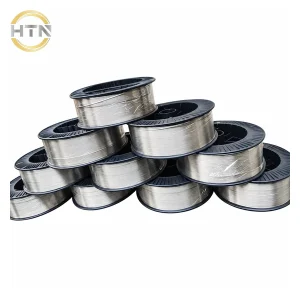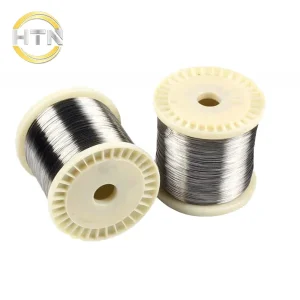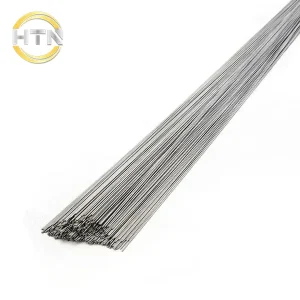






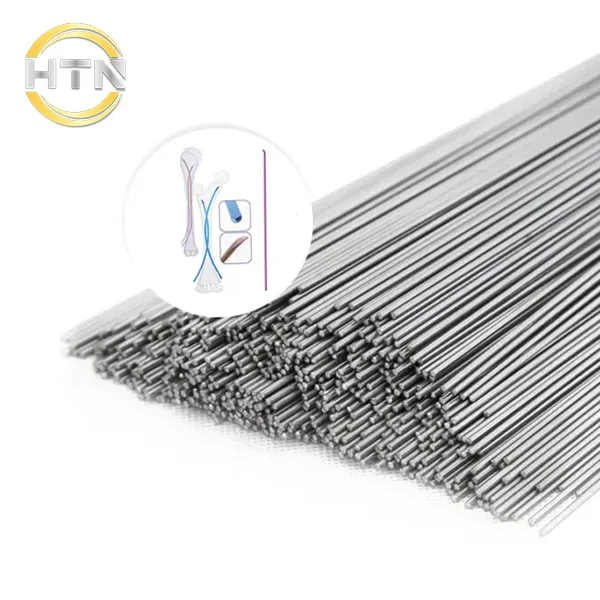
Alambre de titanio sin alear ASTM F67 Grado 4
- Estándar: ASTM F67
- Calificación: Grade 4 (Unalloyed Titanium)
- UNS: R50700
- Formulario de suministro: Coil or straight-length wire
- Condición: Annealed or as ordered
- Rango de diámetro: Ø0,03–Ø7,0 mm
Se ofrecen tamaños personalizables, si bien los parámetros específicos del producto deben confirmarse según la edición estándar y el pedido correspondientes.
Descripción general del producto
ASTM F67 Grade 4 unalloyed titanium wire is wrought commercially pure titanium wire used to manufacture surgical implants, UNS R50700. Grade 4 has the highest specified strength among the four unalloyed grades in ASTM F67. Its strength is obtained through a higher but tightly controlled oxygen level together with limits on iron, nitrogen, carbon and hydrogen, while retaining the corrosion resistance and biocompatibility associated with unalloyed titanium.
The material suits medical wire requiring relatively high strength, good resistance to physiological corrosion and only limited coiling or forming. Compared with Grades 1 through 3, Grade 4 has lower ductility, fine-wire drawability and complex cold-forming capability; processing and device design must be validated for actual diameter, microstructure, fatigue and surface condition. ASTM F67 compliance applies to the raw material and does not by itself approve a finished implant.
| Especificación | Detalles |
| Estándar industrial | ASTM F67 |
| Calificaciones | Gr4 |
| Rango de diámetro | Ø0,03–Ø7,0 mm |
| Diámetros típicos | Ø0,1, 0,2, 0,3, 0,4, 0,5, 0,6, 0,8, 1,0, 1,2, 1,5, 2,0, 2,5, 3,0, 4,0, 5,0, 6,0, 7,0 mm |
| Formulario de suministro | Bobina/carrete o alambre enderezado y cortado |
Límite de uso médico: ASTM F67-compliant titanium wire is medical-device raw material, not an approved finished implant. The device manufacturer remains responsible for design, manufacturing, cleaning, sterilization, biological evaluation, risk management and regulatory compliance.
Características principales
- Highest-strength unalloyed grade: Annealed Grade 4 has the highest specified strength among the four ASTM F67 unalloyed grades and is suited to pure-titanium wire parts requiring greater load capacity and resistance to permanent deformation.
- Química controlada sin alear: No nominal alloying addition is made; O, Fe, N, C and H are tightly controlled to obtain high strength while managing ductility, toughness, drawing consistency and lot uniformity.
- Buena biocompatibilidad: Una película pasiva de TiO2 estable ayuda a limitar la liberación de iones en entornos fisiológicos. El dispositivo final aún requiere una evaluación biológica adecuada.
- Buena resistencia a la corrosión: Su rendimiento suele ser excelente en soluciones salinas, fluidos corporales y muchos cloruros, pero las grietas, la corrosión por fricción, el acoplamiento de metales diferentes y la exposición al fluoruro requieren una evaluación a nivel del dispositivo.
- Buena soldabilidad: Qualified inert-gas, laser or resistance welding may be used; heat input and shielding of fine wire must be tightly controlled to prevent O, N, H and C contamination.
- Lowest forming margin among the four grades: Grade 4 generally has lower elongation, fine-wire drawability and cold-forming margin than Grades 1, 2 and 3. Complex coiling, bending, flattening or end forming may require larger radii, smaller reductions per operation and intermediate annealing. Load-bearing implants still require device-level static, fatigue and risk validation.
Composición química
The following limits apply to ASTM F67 Grade 4. Values are mass percentages. Formal acceptance is governed by the contract edition and producer certified report.
| Elemento | ASTM F67 Grade 4 requirement |
| Nitrógeno, N | ≤0,05% |
| Carbono, C | ≤0,08% |
| Hidrógeno, H | ≤0,015% |
| Hierro, Fe | ≤0.50% |
| Oxígeno, O | ≤0,40% |
| Elementos residuales, cada uno | ≤0,10% |
| Elementos residuales, total | ≤0,40% |
| Titanio, Ti | Balance |
- Referencias técnicas: ASTM F67 official scope and producer data for Grade 4 / UNS R50700.
- Oxígeno, nitrógeno y hierro: Oxygen is the principal interstitial strengthener used to obtain Grade 4 strength; nitrogen and iron also contribute. Grade 4 permits higher oxygen and iron limits than Grade 3, increasing strength while reducing ductility, toughness, fine-wire drawability and complex-forming capability.
- Nitrógeno, carbono e hidrógeno: Estos elementos requieren un control estricto. Un contenido excesivo aumenta la dureza y reduce la ductilidad; el hidrógeno puede favorecer la formación de hidruros y la fragilización.
- Elementos residuales: Es necesario controlar todos los límites, tanto individuales como totales. Analizar únicamente las impurezas principales no satisface los requisitos químicos completos.
- Contenido de titanio: La especificación indica Titanio: Equilibrio. Una declaración de pureza nominal no reemplaza el análisis químico específico del tratamiento térmico ni el informe del material.
Propiedades mecánicas
ASTM F67 specifies room-temperature tensile properties for Grade 4 wrought products. Wire specimens are generally tested along the wire axis; formal acceptance must follow the applicable diameter, specimen form, condition and official standard table.
| Propiedad | ASTM F67 Grade 4 annealed reference | Nota |
| Resistencia a la tracción máxima | ≥550 MPa | La tabla oficial de productos aplicable rige |
| 0,2% límite elástico | 483-655 MPa | Un rango específico, no un mínimo. |
| Alargamiento | ≥15% | Sujeto a las condiciones de tamaño y de la muestra. |
| Reducción de área | Per applicable diameter/specimen requirement | Check the official table when ordered |
ASTM F67 Grade 4 Annealed Titanium Wire Reference Requirements
| Propiedad | Grade 4 annealed reference |
| Resistencia a la tracción máxima | Minimum 550 MPa |
| 0,2% límite elástico | 483-655 MPa |
| Alargamiento | Minimum 15% |
| Módulo de elasticidad | Típico aprox. 105 GPa |
Importante: Mechanical properties must be applied with Grade 4 wire diameter, specimen form, condition and the official table. Generic website data cannot replace contract acceptance, and ASTM F67 raw-material compliance alone does not qualify a finished implant.
Documentación de suministro y calidad de HTN
HTN organizes ASTM F67 Grade 4 unalloyed titanium wire supply to customer purchase requirements. Material is produced by qualified titanium-mill resources. Original mill reports, heat traceability, chemistry and mechanical records can be supplied as agreed. HTN reviews edition, heat number, diameter, tolerance, condition, coil or straight-length form, surface, straightness and packaging, and can arrange independent retesting, straightening, cut-to-length service, clean packaging and third-party inspection.
Aplicaciones típicas
- Raw material for higher-strength orthopedic or trauma-fixation cerclage wire, ligature wire and related parts after device-level validation;
- higher-strength fine wire, mesh or formed-component stock for cranio-maxillofacial, dental and restorative devices;
- surgical-instrument parts requiring relatively high strength, good corrosion resistance and limited forming;
- raw material for implant meshes, support structures, small connecting parts and structural unalloyed titanium wire components;
- medical locating wire, connecting wire, resilient elements and precision formed parts;
- precision titanium wire drawn, straightened, cut or processed to customer drawings;
- Materiales para investigación, prototipos y dispositivos médicos personalizados;
- proyectos internacionales cuando se cumplen la norma ISO 5832-2, así como los requisitos reglamentarios y del cliente.
Límite de aplicación: ASTM F67 Grade 4 titanium wire is raw material for surgical implant manufacture, not an approved finished implant. The final device must separately meet applicable regulations, design validation, biological evaluation, cleaning, sterilization and traceability requirements.
Rellena el formulario a continuación y nuestro equipo estará encantado de ayudarte.
Características de fabricación y mecanizado
Drawing, Straightening and Dimensional Control
Grade 4 wire is typically produced by multiple drawing passes from wire rod. Die condition, area reduction per pass, lubrication, drawing speed and intermediate annealing must be tightly controlled to limit scoring, laps, localized necking, out-of-roundness and residual stress. Because Grade 4 has the highest strength, fine-wire drawing generally requires more conservative reductions, effective lubrication and a carefully validated intermediate-annealing schedule.
Trabajo en frío
Grade 4 may be bent, coiled, woven, flattened or end formed to a limited extent, but its forming margin is lower than Grades 1 through 3. Larger bending or coiling radii, smaller reductions per operation and intermediate annealing may be required. Actual limits depend on diameter, grain size, surface condition and cold-work level.
Recocido y tratamiento térmico
Annealing restores ductility after drawing, lowers residual stress and stabilizes equiaxed alpha microstructure. Unalloyed titanium is not conventionally precipitation hardened; Grade 4 obtains its high strength mainly from controlled interstitial elements, and cold work can further increase strength. Qualified atmospheres are required to prevent oxidation, alpha case and hydrogen pickup.
Soldadura y unión
Qualified GTAW/TIG, laser or resistance welding may be used. Clean thoroughly before welding and fully shield the pool, root and hot heat-affected zone. Fine-wire joints require device-level strength, fatigue, corrosion and cleanliness validation.
Propiedades físicas típicas
The following are typical Grade 4 values near room temperature; unless explicitly specified, they are not mandatory lot-acceptance values of ASTM F67 .
| Propiedad física | Valor de referencia |
| Densidad | Aprox. 4,51 g/cm³ |
| Módulo de elasticidad a temperatura ambiente | Aprox. 105 GPa |
| Conductividad térmica a 21 °C | Aprox. 16 W/(m·K) |
| Coeficiente de dilatación térmica medio, 20-100 °C | Aprox. 8,6 × 10⁻⁶/K |
| Referencia de temperatura de fusión | Aprox. 1670 °C |
| Coeficiente de Poisson | Normalmente, aproximadamente 0,34 |
| Estructura cristalina a temperatura ambiente | HCP alfa titanio |
| Magnetismo | Esencialmente no magnético |
| Mecanismo de fortalecimiento | Principalmente trabajo en frío; no se endurece por envejecimiento convencional. |
| Calor específico a temperatura ambiente | Típicamente aprox. 520 J/(kg·K) |
Physical-property reference: Producer data for Grade 4 / UNS R50700. Values vary with temperature, microstructure, orientation, cold work and heat treatment.
Resistencia a la corrosión
Grade 4 develops a spontaneous, renewable TiO2 passive film and generally resists saline, body fluids and many chloride environments. Actual device performance also depends on surface treatment, crevices, micromotion, dissimilar metals, electrochemical conditions and sterilization or cleaning residues.
Environments in Which Grade 4 Generally Performs Well
- Soluciones salinas y diversos entornos que simulan fluidos corporales;
- aire húmedo y agua de alta pureza;
- soluciones de cloruro neutras;
- muchos ambientes oxidantes;
- procesos de limpieza y pasivación controlados adecuadamente;
- muchos procesos de esterilización de dispositivos médicos después de la validación del dispositivo;
- Contacto prolongado con los tejidos sin irritación;
- entornos validados para dispositivos dentales y ortopédicos.
Entornos que requieren una evaluación cuidadosa
- Limpiadores con flúor, ácido fluorhídrico o afecciones bucales con alto contenido de flúor;
- Acidificación localizada en grietas con escasez de oxígeno;
- Desgaste por fricción, desgaste y corrosión combinados;
- acoplamiento galvánico con metales disímiles inadecuados;
- carga de hidrógeno catódica o tratamiento electroquímico inadecuado;
- ácidos reductores fuertes;
- sales concentradas calientes o productos químicos desinfectantes inusuales;
- áreas que contienen partículas, residuos o daños en la superficie;
- nuevos usos que carecen de validación biológica y de pruebas de corrosión a nivel de dispositivo.
Precaución de ingeniería: La biocompatibilidad y la resistencia a la corrosión por fluidos corporales no dependen únicamente de la calidad del material. La rugosidad, la limpieza, la micromovilidad, el desgaste, las grietas, la presencia de metales diferentes, la exposición al fluoruro y los residuos de esterilización pueden afectar al dispositivo final.
Typical Industry Manufacturing Route for ASTM F67 Grade 4 Titanium Wire
- Selección de materia prima y preparación de la carga: Seleccionar una esponja de alta pureza y calidad, y someterla a un proceso de limpieza rigurosamente controlado, controlando minuciosamente el O, Fe, N, C, H y los residuos.
- Preparación de los electrodos: Homogeneizar, compactar y soldar un electrodo consumible evitando partículas de hierro, aceite, humedad y contaminación extraña.
- Fusión al vacío y producción de lingotes: Se suele utilizar el método VAR u otro método de vacío cualificado. La norma ASTM F67 especifica los requisitos del material acabado; en el pedido deben indicarse las restricciones especiales sobre el contenido de metal fundido o la materia prima.
- Acondicionamiento y despiece de lingotes: Crop unsuitable ends, remove surface defects, and forge or roll to break down the cast structure and produce billet suitable for rod rolling.
- Wire-rod rolling: Roll the billet to coil or wire rod under controlled temperature, managing structure uniformity, dimensions, scale and surface defects.
- Surface conditioning and preliminary annealing: Use validated pickling, mechanical peeling or another suitable method to remove scale and alpha case while controlling hydrogen pickup and iron contamination.
- Multi-pass drawing: Draw progressively through qualified dies to the target diameter. Apply intermediate annealing according to cold work and control diameter tolerance, out-of-roundness, surface quality and mechanical properties.
- Final annealing, straightening and cleaning: Apply final annealing or stress relief as ordered. Supply as coil wire or straightened cut lengths, and use validated cleaning to remove lubricant, abrasive, iron and pickling residues.
- Inspección: Verify chemistry, tensile properties, diameter, out-of-roundness, surface and appearance; check length and straightness for straight wire. Special microstructure, grain size, roughness or nondestructive testing must be ordered when required.
- Identificación, embalaje y trazabilidad: Maintain heat, lot, coil/straight wire and report correspondence. Use clean spools, coils or protective tubes to prevent tangling, kinking, scratches and cross-contamination.
Nota sobre fabricación e inspección: ASTM F67 specifies material requirements, but special melt count, microstructure, grain size, tight diameter tolerance, out-of-roundness, straightness, surface roughness, clean packaging, EN 10204 3.1 documentation and third-party inspection must be confirmed in the purchase order.