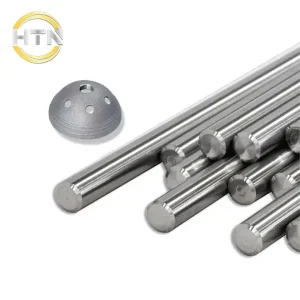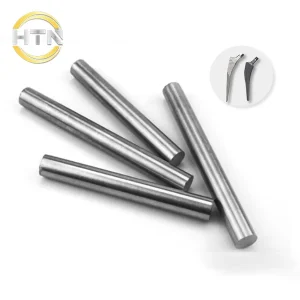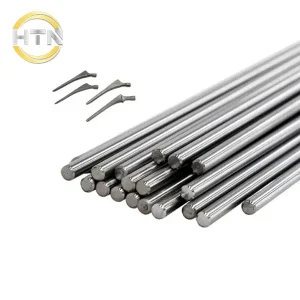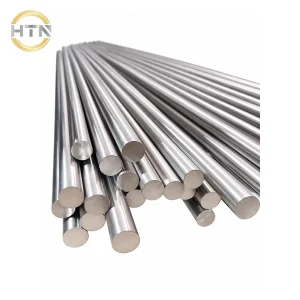






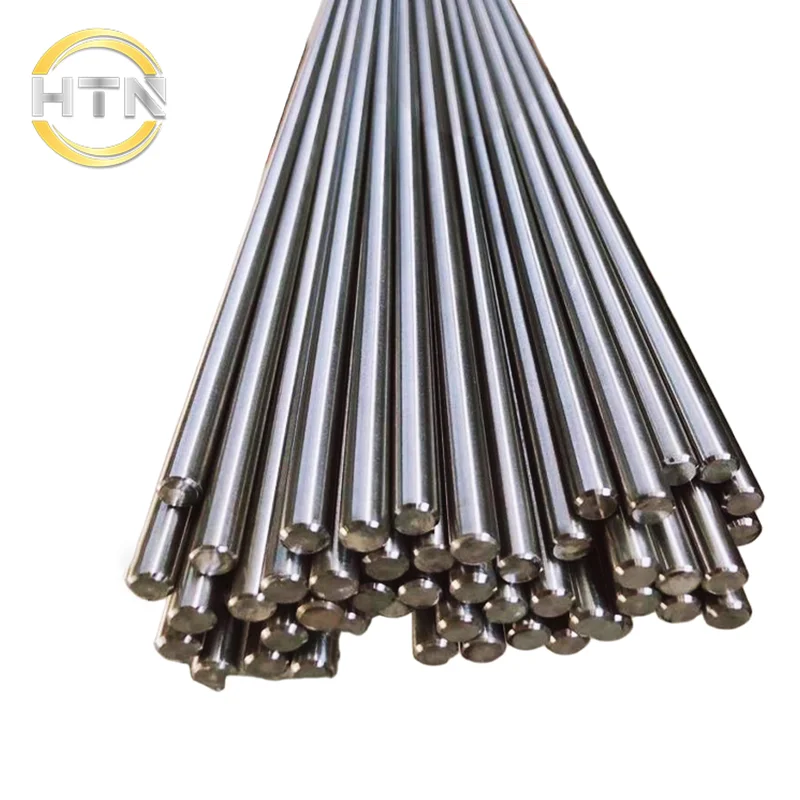
ASTM B348 Grade 1 Titanium Bar
- Standard: ASTM B348
- Grade: Grade 1 (Commercially Pure Titanium)
- UNS: R50250
- Condition: Annealed
- Dia: φ7 ~ φ300 mm
- Typical Industrial Bar Length: 200–3000 mm
Customizable sizes are available, while specific product parameters should be confirmed per the applicable standard edition and order.
Product Overview
HTN coordinates the supply of ASTM B348 Grade 1 titanium bar through evaluated manufacturing partners. The applicable standard edition, grade, dimensions, condition, inspection documents and any additional testing requirements are confirmed for each order. Order-specific MTCs and heat or lot traceability documents are available as agreed.
Grade 1 titanium bar combines low density, excellent corrosion resistance, good weldability and high ductility. It is well suited to components that require cold forming, resistance to chloride-bearing environments and controlled material purity, provided that very high structural strength is not the primary design requirement.
| Specification | Details |
| Industrial Standard | ASTM B348 |
| Industrial Grades | Gr1 |
| Diameter Range | Ø7 – Ø300 mm |
| Typical Diameters | Ø7, 8, 10, 12, 14, 16, 18, 20, 25, 30, 35, 40, 45, 50, 60, 70, 80, 90, 100, 120, 150, 200 mm |
| Typical Industrial Bar Length | 200–3000 mm; cut-to-length available |
| Surface / Supply Condition | Hot-rolled black surface / Turned / Ground |
| Precision Tolerance | h6 / h7 / h8 available subject to diameter, finishing process and order confirmation |
Main Characteristics
- Excellent ductility and formability: Grade 1 is the most formable of the commonly used CP titanium grades and is suitable for cold bending, spinning, stamping and other substantial plastic deformation.
- Excellent corrosion resistance: A dense and stable titanium-oxide passive film forms naturally on the surface and can repassivate when oxygen or moisture is available.
- Low density: Its density is approximately 4.51 g/cm³, about 60% of that of ordinary steels.
- Good weldability: Grade 1 can be welded by TIG/GTAW, plasma and electron-beam processes, provided that the weld pool, completed weld and hot heat-affected zone are fully shielded.
- Good low-temperature toughness: CP titanium does not normally show the pronounced ductile-to-brittle transition associated with some steels.
- Not significantly strengthened by conventional heat treatment: Strength is controlled mainly through interstitial chemistry, grain size and cold work; annealing restores ductility and relieves processing stress.
Chemical Composition
The following limits are commonly specified for ASTM B348 Grade 1. Values are mass percentages.
| Element | ASTM B348 Grade 1 requirement |
| Nitrogen, N | ≤0.03% |
| Carbon, C | ≤0.08% |
| Hydrogen, H | ≤0.015% |
| Iron, Fe | ≤0.20% |
| Oxygen, O | ≤0.18% |
| Residual elements, each | ≤0.10% |
| Residual elements, total | ≤0.40% |
| Titanium, Ti | Balance |
- Oxygen and nitrogen: Increase strength and hardness, but excessive levels reduce ductility, toughness and formability.
- Iron: Contributes to strength; excessive iron may affect microstructural uniformity and corrosion performance.
- Hydrogen: Must be strictly controlled because excessive hydrogen may form hydrides and increase embrittlement risk.
- Titanium content: ASTM uses “Titanium: Balance.” A fixed statement such as “Ti ≥99.5%” should not be used unless supported by the actual heat analysis or an additional producer guarantee.
Mechanical Properties
The following requirements apply to annealed ASTM B348 Grade 1 bar. Formal acceptance shall consider the specified edition, product dimensions, test orientation and the producer′s certified test report.
| Property | Requirement | Status |
| Ultimate tensile strength, Rm | ≥240 MPa | ASTM minimum |
| 0.2% offset yield strength, Rp0.2 | ≥138 MPa | ASTM minimum |
| Elongation in 4D | ≥24% | ASTM minimum |
| Reduction of area | ≥30% | ASTM minimum |
Typical Room-Temperature Properties (Not Guaranteed)
| Property | Reference value |
| Ultimate tensile strength | Approx. 345 MPa |
| 0.2% yield strength | Approx. 220 MPa |
| Elongation | Approx. 35% |
| Reduction of area | Approx. 70% |
HTN Supply and Quality Documentation
HTN organizes the supply of ASTM B348 Grade 1 titanium bar according to customer purchase requirements. Materials are sourced from evaluated manufacturing partners. The applicable source, grade, standard, dimensions, condition and documentation are confirmed for each order. Original mill test reports, heat traceability, chemical analysis and mechanical-property records can be supplied as agreed. HTN reviews the applicable standard, heat number, inspection documents, dimensions and delivery condition, and can arrange independent retesting, subject to product size, applicable standard, acceptance criteria and order confirmation, cut-to-length service and third-party inspection when required by the project.
Typical Applications
- Valve stems, pump shafts, agitator shafts and connecting components for chemical equipment;
- corrosion-resistant parts for desalination and marine engineering;
- electroplating racks, anode baskets and electrochemical equipment;
- tube-sheet components and connections for heat exchangers;
- industrial parts requiring substantial cold forming;
- food, pharmaceutical and high-purity-fluid equipment;
- non-high-load components for cryogenic equipment;
- corrosion-resistant fasteners, shafts and machined components.
Fill in the form below and our team will be happy to assist you
Fabrication and Machining Characteristics
Machining
Grade 1 is relatively machinable within the titanium family, but titanium has low thermal conductivity, noticeable elastic recovery and a tendency to adhere to tools at high cutting temperatures. Sharp rigid tools, stable feed, abundant coolant and avoidance of dwell or rubbing are recommended.
Cold working
Grade 1 has excellent cold-bending and cold-forming capability. Cold work increases strength and hardness while reducing ductility; intermediate annealing may be used after substantial deformation.
Hot working
Hot forging and hot rolling may be used. Temperature, reduction and reheating cycles must follow a qualified process to prevent excessive grain growth, oxygen pickup and an excessively thick alpha case.
Welding
TIG/GTAW and other suitable fusion processes may be used. The weld face, root and hot heat-affected zone require complete inert-gas protection. Oil, moisture, iron particles and foreign contamination must be excluded.
Typical Physical Properties
The following are typical reference values near room temperature. They are not mandatory lot-acceptance requirements of ASTM B348.
| Physical property | Typical value |
| Density | 4.51 g/cm³ |
| Elastic modulus | 105–120 GPa |
| Thermal conductivity | Approx. 21.97 W/(m·K) |
| Electrical resistivity | Approx. 0.45 μΩ·m |
| Mean CTE, 20–100°C | Approx. 8.6×10⁻⁶/K |
| Mean CTE, 20–300°C | Approx. 9.5×10⁻⁶/K |
| Specific heat | Approx. 0.52 kJ/(kg·K) |
| Beta transus | Approx. 890°C |
| Reference melting point of titanium | Approx. 1668°C |
| Magnetism | Essentially non-magnetic |
Corrosion Resistance
The corrosion resistance of Grade 1 titanium bar comes primarily from a stable passive oxide film that forms naturally on its surface. If slightly damaged, the film generally reforms when oxygen or moisture is available.
Service suitability depends on temperature, concentration, aeration, contaminants, stress and other operating conditions. Customers remain responsible for final material selection and should obtain application-specific engineering or corrosion advice where required.
Environments in Which Grade 1 Generally Performs Well
- Seawater, salt spray and humid air;
- neutral chloride and brine solutions;
- many oxidizing acid environments;
- nitric acid and some oxidizer-containing process streams;
- many organic acids and organic compounds;
- alkaline media;
- wet chlorine and hydrated halogen environments;
- many food, pharmaceutical and high-purity-water systems.
Environments Requiring Careful Evaluation
- Strong reducing acids under oxygen-starved conditions;
- hot concentrated hydrochloric or sulfuric acid;
- fluoride-containing media or hydrofluoric acid;
- tight crevices in hot concentrated chloride or sulfate solutions;
- anhydrous methanol or halide-contaminated methanol;
- red fuming nitric acid;
- molten chloride salts;
- cathodic-protection or electrochemical conditions that may promote hydrogen absorption;
- dissimilar-metal contact with an unsuitable galvanic design.
Typical Industry Manufacturing Route
- Raw-material selection and charge preparation: Select qualified titanium sponge and controlled clean revert, with particular attention to oxygen, iron, nitrogen, hydrogen and foreign contamination, while HTN coordinates supply through evaluated manufacturing partners.
- Electrode preparation: Compact the charge into electrode blocks and weld them into a consumable electrode while preventing contamination from iron particles, oil and moisture.
- Vacuum melting and ingot production: Vacuum arc remelting is common; electron-beam or another qualified route may also be used. The charge is melted in vacuum and solidified in a water-cooled copper crucible.
- Ingot conditioning: Crop the head and bottom and remove unsuitable surface or shrinkage-affected material by peeling, machining or grinding.
- Breakdown forging: Convert the ingot into billet through controlled forging reductions to refine the cast structure and improve internal uniformity.
- Hot rolling or precision forging: Medium and smaller bars may be hot rolled or precision forged; large bars are commonly forged; small precision bars may be cold drawn, turned or centerless ground.
- Annealing: Reduce processing stress, restore ductility and stabilize the structure. TIMETAL 35A lists a representative anneal of approximately 700°C for one hour followed by air cooling, but the actual cycle depends on section size, deformation, furnace and qualified procedure.
- Surface finishing: Descaling, blasting, pickling, rough turning, finish turning, centerless grinding or polishing may be used. Pickling must be controlled to limit hydrogen pickup.
- Straightening and cutting: Straighten, cut to length, finish the ends and inspect diameter, length, ovality, straightness and surface condition.
- Inspection and traceability: Verify chemistry, tensile properties, dimensions and surface condition, and maintain the relationship among heat number, lot and material-test documentation.