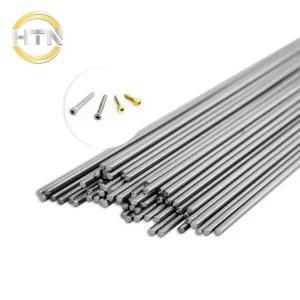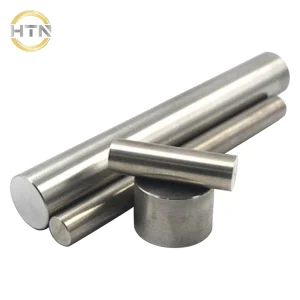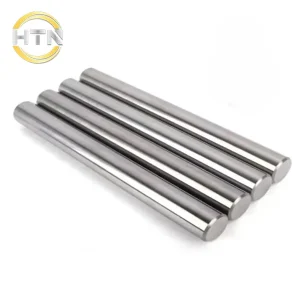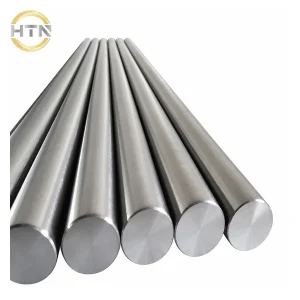






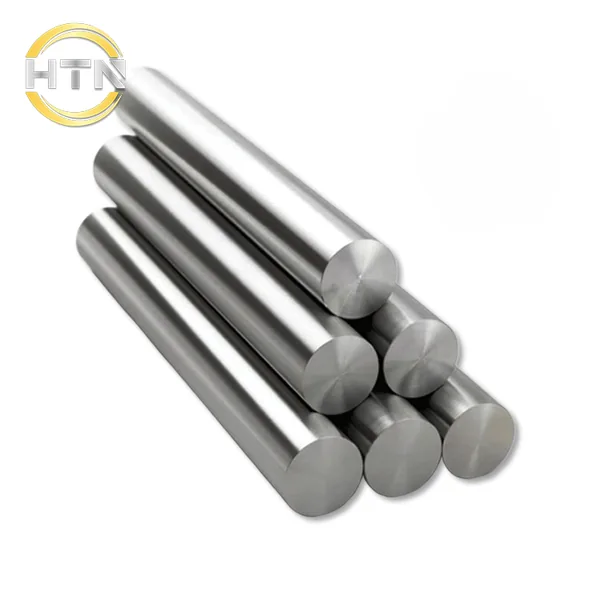
ASTM B348 Grade 5 Titanium Rod
- Standard: ASTM B348
- Grade: Grade 5
- UNS: R56400
- Condition: Annealed
- Dia: φ7 ~ φ300 mm
- Typical Industrial Bar Length: 200–3000 mm
Customizable sizes are available, while specific product parameters should be confirmed per the applicable standard edition and order.
Product Overview
ASTM B348 Grade 5 titanium rod (titanium bar) is an alpha-beta titanium alloy bar produced and tested to ASTM B348/B348M. It is Ti-6Al-4V, UNS R56400. Aluminum is the alpha stabilizer and vanadium is the beta stabilizer, giving the alloy high specific strength, corrosion resistance and the capability for heat-treatment strengthening.
Grade 5 is one of the most widely used engineering titanium alloys. When the strength of commercially pure Grades 1-4 is insufficient, Grade 5 provides substantially higher load-carrying capability. Its strength, fatigue potential, heat-treatability and corrosion resistance suit parts with demanding mass and structural-reliability requirements; its cold-forming latitude and post-weld property control are correspondingly more demanding than for CP titanium.
Grade 5 rod/bar is used for aerospace structural parts, high-strength fasteners, shafts, connectors, valves, pump components, motorsport and sporting-goods parts, marine hardware and high-performance machined parts. It may also be used as raw material for medical devices and implants only when the applicable specification is satisfied.
| Specification | Details |
| Industrial Standard | ASTM B348 |
| Industrial Grades | Gr5 |
| Diameter Range | Ø7 – Ø300 mm |
| Typical Diameters | Ø7, 8, 10, 12, 14, 16, 18, 20, 25, 30, 35, 40, 45, 50, 60, 70, 80, 90, 100, 120, 150, 200 mm |
| Typical Industrial Bar Length | 200–3000 mm; cut-to-length available |
| Surface / Supply Condition | Hot-rolled black surface / Turned / Ground |
| Precision Tolerance | h6 / h7 / h8 available subject to diameter, finishing process and order confirmation |
Application boundary: ASTM B348 is an industrial titanium-alloy bar and billet specification. Surgical implant use cannot be justified by an ASTM B348 Grade 5 certificate alone and may require ASTM F136 or another applicable medical specification, the customer drawing, regulations and a suitable quality system.
Main Characteristics
- High strength and high specific strength: Annealed ASTM B348 material has a minimum tensile strength of 895 MPa, minimum 0.2% offset yield strength of 828 MPa and minimum elongation of 10%, supporting high-strength, weight-efficient structural parts.
- Heat-treatable alpha-beta alloy: Solution treatment and aging can provide higher strength. Actual properties depend on section size, heat-treatment schedule and the qualified manufacturing process.
- Excellent strength-to-weight potential: Density is approximately 4.43 g/cm³, about 56% of steel density, while delivering high strength for aerospace and performance engineering applications.
- Good fabricability with controlled machining: Grade 5 can be forged, rolled, drawn, turned, milled, drilled, ground and threaded. Its low thermal conductivity and tendency to gall require titanium-appropriate tools, cutting parameters and coolant.
- Good corrosion resistance: A stable titanium-oxide passive film forms naturally and provides useful resistance in many seawater, oxidizing and general industrial environments.
- Weldability with safeguards: TIG, MIG, plasma, laser and electron-beam welding may be used with complete inert-gas shielding. Critical load-bearing welds require qualified procedures and assessment of weld properties and any post-weld heat treatment.
- Essentially non-magnetic: Useful in some equipment and instruments sensitive to magnetic response.
- Service temperature and microstructure must be controlled: Long-term temperature, heat-treatment condition, microstructure and surface condition must be confirmed against the applicable design specification rather than general product literature alone.
Chemical Composition
ASTM B348 Grade 5 chemistry is controlled to the following mass-percent limits:
| Element | ASTM B348 Grade 5 requirement |
| Nitrogen, N | ≤0.050% |
| Carbon, C | ≤0.080% |
| Hydrogen, H | ≤0.015% |
| Iron, Fe | ≤0.400% |
| Oxygen, O | ≤0.200% |
| Aluminum, Al | 5.50%–6.75% |
| Vanadium, V | 3.50%–4.50% |
| Residual elements, each | ≤0.100% |
| Residual elements, total | ≤0.400% |
| Titanium, Ti | Balance |
- Technical references: ASTM B348/B348M, ATI Ti-6Al-4V Grade 5 data and related Grade 5 product data.
- Aluminum and vanadium: Aluminum stabilizes alpha and vanadium stabilizes beta. Their controlled combination gives Grade 5 its alpha-beta microstructure and heat-treatability.
- Oxygen, nitrogen, carbon and hydrogen: These must be controlled. Oxygen, nitrogen and carbon can increase strength but reduce ductility and toughness; excessive hydrogen may form brittle hydrides and increase embrittlement risk.
- Titanium content: ASTM states Titanium: Balance. Final chemistry shall be confirmed by the original mill test report for the applicable heat.
- Lot acceptance: If an order cites an AMS, medical specification or customer drawing, its composition limits and additional element requirements may be stricter than ASTM B348 and must be confirmed separately.
ASTM Mechanical Requirements
The following room-temperature tensile requirements apply to annealed ASTM B348 Grade 5 bar. The specified edition, dimensions, specimen form and test orientation must also be considered for formal acceptance.
| Property | Requirement | Status |
| Ultimate tensile strength, Rm | ≥895 MPa | ASTM minimum |
| 0.2% offset yield strength, Rp0.2 | ≥828 MPa | ASTM minimum |
| Elongation in the specified gauge length | ≥10% | ASTM minimum |
| Reduction of area | ≥25% | ASTM minimum |
Typical Room-Temperature Properties (Not Guaranteed)
| Property | Reference Value |
| Ultimate tensile strength | Approx. 950–1070 MPa |
| 0.2% offset yield strength | Approx. 880–1015 MPa |
| Elongation | Approx. 15–20% |
| Reduction of area | Approx. 38–51% |
| Elastic modulus | Approx. 110–114 GPa |
| Typical bend radius | Evaluate for part design, dimensions and forming route |
Important: Typical data are not ASTM acceptance values and are not automatically guaranteed for every lot. If hardness, fatigue, fracture toughness, microstructure, UT or solution-treated-and-aged performance is required, it should be stated separately in the purchase order.
HTN Supply and Quality Services
ASTM B348 Grade 5 titanium bar is produced by evaluated, qualified mill resources. HTN confirms technical requirements from customer drawings and purchase specifications, selects a mill with the appropriate capability, reviews the original MTR and heat/lot records, and verifies the relationship among the material standard, dimensions, quantity, condition and inspection documents.
When agreed in the contract, HTN can coordinate independent retesting, ultrasonic examination, PMI, cut-to-length service, turning or grinding, EN 10204 3.1 documentation and third-party inspection, together with export packing, shipping documents and international delivery.
Typical Applications
- Aerospace structural components, brackets, connectors, fasteners and machined parts;
- High-strength shafts, valve stems, pump components, flanges and pressure-equipment parts;
- Marine engineering, shipboard, desalination and energy equipment;
- Motorsport, sporting goods, unmanned systems and lightweight high-performance components;
- Corrosion-resistant machined parts for applicable petrochemical, chemical and general industrial equipment;
- Medical devices and implant raw material only when the applicable standard, drawing and regulatory requirements are satisfied;
- High-strength fasteners, spring elements, connection systems and custom engineering parts;
- Engineering parts requiring light weight, high strength, corrosion resistance and heat-treatability.
Fill in the form below and our team will be happy to assist you
Fabrication and Processing Characteristics
Machining
Grade 5 can be turned, milled, drilled, ground and threaded. Because it has low thermal conductivity, high strength, noticeable elastic recovery and a tendency to gall, sharp rigid tools, low-to-moderate cutting speed, stable feed and abundant non-chlorinated cutting fluid are recommended. Dwell and rubbing should be avoided.
Cold forming
Grade 5 can be bent, stamped, drawn and spun, but has less room-temperature forming latitude than commercially pure titanium. Complex shapes may require larger bend radii, staged forming, intermediate annealing, warm forming or hot forming. The route should be verified by trial or qualified procedure.
Hot working
Hot forging, rolling, extrusion and pressing may be used. Working temperature relative to the beta transus, soak time, reduction and atmosphere must follow a qualified procedure to obtain the required alpha-beta microstructure and limit grain coarsening, oxidation and alpha-case formation.
Welding
Grade 5 can be welded, but the weld pool, face, root and hot heat-affected zone must receive complete high-purity inert-gas shielding. Critical load-bearing weldments should be assessed for joint strength, ductility, fatigue performance and any necessary post-weld heat treatment.
Wear resistance
Grade 5 has higher strength but may still gall, seize and score in sliding contact. Coatings, surface hardening, lubrication, bushings or optimized mating materials should be evaluated for high-friction pairs.
Machining safety: Fine titanium chips and powders are combustible. They must be collected, stored and handled away from ignition sources in accordance with applicable fire and occupational-safety requirements.
Typical Physical Properties
The following are typical reference values near room temperature and are not mandatory lot-acceptance requirements of ASTM B348:
| Physical property | Typical value |
| Density | Approx. 4.43 g/cm³ |
| Elastic modulus | Approx. 110–114 GPa |
| Specific heat at room temperature | Approx. 0.53 J/(g·K) |
| Thermal conductivity | Approx. 6.7 W/(m·K) |
| Electrical resistivity | Approx. 1.7–1.8 μΩ·m |
| Mean CTE, 20–100°C | Approx. 8.6×10⁻⁶/K |
| Mean CTE, 20–315°C | Approx. 9.2×10⁻⁶/K |
| Beta transus | Approx. 980–1000°C |
| Melting range | Approx. 1604–1660°C |
| Poisson’s ratio | Approx. 0.31–0.37 |
| Magnetism | Generally regarded as non-magnetic |
Physical-property references: ATI Ti-6Al-4V Grade 5 and related Grade 5 data. Values vary with temperature, heat, orientation, section size and heat-treatment condition.
Corrosion Resistance
The corrosion resistance of Grade 5 titanium rod/bar is based on a continuous, tightly adherent passive titanium-oxide film. If the film is slightly damaged, it generally reforms when oxygen or moisture is available.
Environments in Which Grade 5 Generally Performs Well
- Natural seawater, marine atmospheres, salt spray and flowing seawater;
- many neutral aqueous solutions, brines and general industrial water media;
- nitric acid and many oxidizing acid environments;
- wet chlorine and some halogen environments where sufficient moisture is present;
- many alkaline solutions, organic compounds and aqueous salt solutions;
- applicable service in aerospace, marine, energy, petrochemical and general industrial equipment.
Environments Requiring Careful Evaluation
- Hot, concentrated or oxygen-starved strongly reducing acids;
- stressed hot-chloride environments, tight crevices and deposits;
- fluoride-bearing media or hydrofluoric acid;
- anhydrous methanol or halide-contaminated methanol;
- red fuming nitric acid and molten chloride salts;
- liquid mercury, cadmium and related special environments;
- completely dry chlorine service;
- pickling, cathodic protection or electrochemical conditions that may promote hydrogen pickup.
Engineering caution: Corrosion behavior depends on concentration, temperature, pH, aeration, velocity, impurities, crevices, deposits, residual stress, surface condition and dissimilar-metal contact. Product literature supports preliminary material selection but cannot replace corrosion testing and engineering review under the actual service conditions.
Typical Industry Manufacturing Route for Grade 5 Titanium Rod
- Raw-material and alloying preparation: Select qualified titanium sponge, aluminum-vanadium master alloy and approved clean revert, controlling oxygen, nitrogen, carbon, hydrogen, iron and foreign contamination.
- Electrode preparation: Compact the charge into electrode blocks and assemble the melting electrode with uniform composition while excluding oil, moisture and iron-bearing foreign matter.
- Vacuum melting and ingot production: Use VAR, electron-beam cold-hearth melting or another approved titanium-alloy melting route. The melting route and number of melts follow the qualified mill process and purchase requirements.
- Ingot conditioning and chemistry: Crop, peel or grind as necessary, complete the required chemical analysis, retain heat identification and perform necessary internal-quality controls.
- Breakdown forging: Upset, draw or multi-directionally forge the ingot to break down the cast structure, improve internal uniformity and produce billet for further working.
- Alpha-beta hot working and bar formation: Forge, hot roll, extrude, draw or combine processes to produce the required section. Control deformation temperature, reduction and cooling path to obtain a stable microstructure. Precision small bars may be turned or centerless ground.
- Heat treatment: Anneal to stabilize microstructure and obtain the required strength-ductility balance. When higher strength is ordered, solution treatment and aging may be applied under a qualified procedure. Temperature, hold time and cooling method follow the qualified process and ordered condition.
- Surface conditioning: Turn, grind, blast, pickle or combine processes to remove scale and alpha case. Pickling must be controlled to limit hydrogen pickup and meet surface-quality requirements.
- Straightening and finishing: Straighten, cut, chamfer, turn, grind or polish to achieve the specified diameter, length, straightness and surface quality.
- Final inspection: Verify chemistry, room-temperature tensile properties, dimensions, tolerances, straightness, surface condition and product identification. UT, PMI, microstructure, hardness or other tests are performed when ordered.
- Documentation and traceability: Maintain the relationship among the physical material, labels, heat number, lot, dimensions, heat-treatment condition and original mill test report.
- Packing and delivery: Protect the finished surface and use suitable export packing and transport markings to prevent impact, scratching, moisture and dissimilar-metal contamination.
Melting and inspection note: ASTM B348 does not prescribe a fixed double- or triple-VAR route for every Grade 5 rod/bar. UT, PT, PMI, microstructure, hardness, EN 10204 3.1 and third-party inspection must be ordered when required.