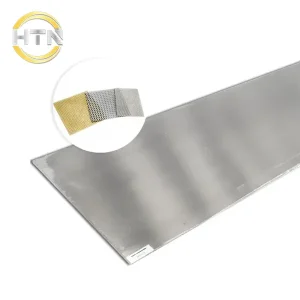






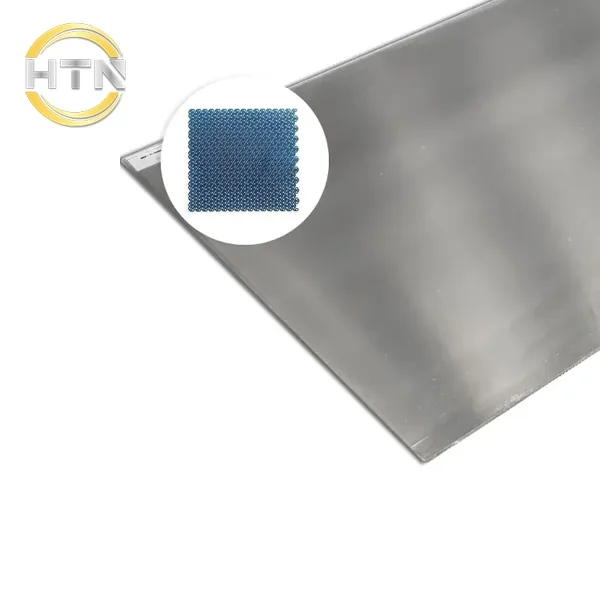
ASTM F67 Grade 4 Unalloyed Titanium Plate & Sheet
- Standard: ASTM F67
- Grade: Grade 4 (Unalloyed Titanium)
- UNS: R50700
- Supply form: Plate, sheet or strip
- Condition: Annealed, as ordered
- Thickness: 0.3–60 mm; Customizable up to 100 mm
- Width: 400–2000 mm
- Length: 1000–6000 mm
Customizable sizes are available, while specific product parameters should be confirmed per the applicable standard edition and order.
Product Overview
ASTM F67 Grade 4 unalloyed titanium plate, sheet and strip are wrought commercially pure titanium flat products used to manufacture surgical implants, UNS R50700. Grade 4 has the highest specified strength among the four unalloyed grades in ASTM F67. Its strength is obtained through a higher but tightly controlled oxygen level together with limits on iron, nitrogen, carbon and hydrogen, while retaining the corrosion resistance and biocompatibility associated with unalloyed titanium.
The material suits medical flat products requiring relatively high strength, good resistance to physiological corrosion and only limited forming. Compared with Grades 1 through 3, Grade 4 has lower ductility, deep drawability and complex cold-forming capability; processing and device design must be validated for actual thickness, rolling direction, microstructure, fatigue and surface condition. ASTM F67 compliance applies to the raw material and does not by itself approve a finished implant.
| Specification | Cold-Rolled Titanium Sheet | Hot-Rolled Titanium Plate |
| Standard | ASTM F67 | |
| Grades | Gr4 | |
| Thickness | 0.3–4.75 mm | 0.5–20 mm |
| Standard Stock Thicknesses | 0.5 / 0.6 / 0.8 / 1.0 / 1.5 / 2.0 / 2.5 / 3.0 / 4.0mm | 5 / 6 / 8 / 10 / 12 / 15 / 20 / 25 / 30 / 35 / 40 / 50 / 60 mm |
| Width | 400–1200 mm | 400–1000 mm |
| Length | 1000–3000 mm | 1000–2000 mm |
| Note | Sheet Thickness ≤ 4.75 mm | Medical Titanium Plate & Sheet Typical thickness 0.5–20 mm; width ≤1200 mm; polished or pickled surfaces available. |
Medical-use boundary: ASTM F67-compliant sheet and plate is medical-device raw material, not an approved finished implant. The device manufacturer remains responsible for design, manufacturing, cleaning, sterilization, biological evaluation, risk management and regulatory compliance.
Main Characteristics
- Highest-strength unalloyed grade: Annealed Grade 4 has the highest specified strength among the four ASTM F67 unalloyed grades and is suited to pure-titanium plate and sheet parts requiring greater load capacity and resistance to permanent deformation.
- Controlled unalloyed chemistry: No nominal alloying addition is made; O, Fe, N, C and H are tightly controlled to obtain high strength while managing ductility, toughness, rolling consistency and lot uniformity.
- Good biocompatibility: A stable TiO2 passive film helps limit ion release in physiological environments. The finished device still requires applicable biological evaluation.
- Good corrosion resistance: Performance is generally excellent in saline, body fluids and many chlorides, but crevices, fretting corrosion, dissimilar-metal coupling and fluoride exposure require device-level evaluation.
- Good weldability: Qualified inert-gas, laser or resistance welding may be used; hot metal must be protected from O, N, H and C contamination.
- Lowest forming margin among the four grades: Grade 4 generally has lower elongation, deep drawability and cold-forming margin than Grades 1, 2 and 3. Complex bending, stamping or drawing may require larger radii, smaller reductions per operation and intermediate annealing. Load-bearing implants still require device-level static, fatigue and risk validation.
Chemical Composition
The following limits apply to ASTM F67 Grade 4. Values are mass percentages. Formal acceptance is governed by the contract edition and producer certified report.
| Element | ASTM F67 Grade 4 requirement |
| Nitrogen, N | ≤0.05% |
| Carbon, C | ≤0.08% |
| Hydrogen, H | ≤0.015% |
| Iron, Fe | ≤0.50% |
| Oxygen, O | ≤0.40% |
| Residual elements, each | ≤0.10% |
| Residual elements, total | ≤0.40% |
| Titanium, Ti | Balance |
Technical references: ASTM F67 official scope and producer data for Grade 4 / UNS R50700.
- Oxygen, nitrogen and iron: Oxygen is the principal interstitial strengthener used to obtain Grade 4 strength; nitrogen and iron also contribute. Grade 4 permits higher oxygen and iron limits than Grade 3, increasing strength while reducing ductility, toughness, deep drawability and complex-forming capability.
- Nitrogen, carbon and hydrogen: These elements require strict control. Excess content raises hardness and reduces ductility; hydrogen may promote hydrides and embrittlement.
- Residual elements: Each and total limits must be controlled. Testing only the principal impurities does not satisfy the full chemistry requirement.
- Titanium content: The specification states Titanium: Balance. A nominal purity claim does not replace heat-specific chemical analysis and the material report.
Mechanical Properties
ASTM F67 specifies room-temperature tensile properties for Grade 4 wrought products. Flat-product specimens are generally taken longitudinal to the rolling direction; formal acceptance must follow the applicable thickness, sampling direction, specimen form, condition and official standard table.
| Property | ASTM F67 Grade 4 annealed reference | Note |
| Ultimate tensile strength | ≥550 MPa | Official applicable product table governs |
| 0.2% yield strength | 483-655 MPa | A specified range, not one minimum |
| Elongation | ≥15% | Subject to size and specimen conditions |
| Reduction of area | Normally not applicable to flat tensile specimens | Confirm against the applicable product/specimen requirement |
ASTM F67 Grade 4 Annealed Plate/Sheet Reference Requirements
| Property | Grade 4 annealed reference |
| Ultimate tensile strength | Minimum 550 MPa |
| 0.2% yield strength | 483-655 MPa |
| Elongation | Minimum 15% |
| Elastic modulus | Typical approx. 105 GPa |
Important: Mechanical properties must be applied with plate/sheet thickness, rolling direction, specimen form and the official table. Generic website data cannot replace contract acceptance, and ASTM F67 raw-material compliance alone does not qualify a finished implant.
HTN Supply and Quality Documentation
HTN organizes ASTM F67 Grade 4 unalloyed titanium plate, sheet and strip supply to customer purchase requirements. Material is produced by qualified titanium-mill resources. Original mill reports, heat traceability, chemistry and mechanical records can be supplied as agreed. HTN reviews edition, heat number, thickness, width, length, tolerance, condition, rolling direction, surface, flatness and packaging, and can arrange independent retesting, cut-to-size service, clean packaging and third-party inspection.
Typical Applications
- Higher-strength stock for orthopedic, trauma or cranio-maxillofacial fixation plates and related parts after device-level validation;
- higher-strength plate and sheet parts for dental, cranio-maxillofacial and restorative devices;
- surgical-instrument sheet parts requiring relatively high strength, good corrosion resistance and limited forming;
- raw material for implant components, shells, supports and structural unalloyed titanium parts;
- medical cover plates, connection tabs, locating pieces and support parts;
- precision plate and sheet parts cut, formed or machined to customer drawings;
- research, prototype and custom medical-device material;
- international projects when ISO 5832-2, regulatory and customer requirements are also met.
Application boundary: ASTM F67 Grade 4 sheet and plate is raw material for surgical implant applications, not an approved finished implant. The final device must separately meet applicable regulations, design validation, biological evaluation, cleaning, sterilization and traceability requirements.
Fill in the form below and our team will be happy to assist you
Fabrication and Machining Characteristics
Rolling, Cutting and Dimensional Control
Grade 4 plate and sheet may be cut by shearing, sawing, waterjet or validated machining methods. Because of its higher strength, use sharp tools, rigid support, ample coolant and controlled feed, then remove burrs and contaminated edges to limit heat buildup, adhesion, surface damage and residual tensile stress.
Cold working
Grade 4 may be cold bent, stamped, drawn, spun or roll formed to a limited extent, but its forming margin is lower than Grades 1 through 3. Larger bend radii, smaller reductions per operation and intermediate annealing may be required. Actual limits depend on thickness, rolling direction, grain size, surface condition and cold-work level.
Annealing and heat treatment
Annealing restores ductility, lowers residual stress and stabilizes equiaxed alpha microstructure. Unalloyed titanium is not conventionally precipitation hardened; Grade 4 obtains its high strength mainly from controlled interstitial elements, and cold work can further increase strength. Qualified atmospheres are required to prevent oxidation, alpha case and hydrogen pickup.
Welding and joining
Qualified GTAW/TIG, laser or resistance welding may be used. Clean thoroughly before welding and fully shield the pool, root and hot heat-affected zone. Device welds require strength, fatigue, corrosion and cleanliness validation.
Typical Physical Properties
The following are typical Grade 4 values near room temperature; unless explicitly specified, they are not mandatory lot-acceptance values of ASTM F67 .
| Physical property | reference value |
| Density | Approx. 4.51 g/cm³ |
| Elastic modulus at room temperature | Approx. 105 GPa |
| Thermal conductivity at 21°C | Approx. 16 W/(m·K) |
| Mean CTE, 20-100°C | Approx. 8.6×10⁻⁶/K |
| Melting temperature reference | Approx. 1670°C |
| Poisson’s ratio | Typically approx. 0.34 |
| Crystal structure at room temperature | HCP alpha titanium |
| Magnetism | Essentially non-magnetic |
| Strengthening mechanism | Mainly cold work; not conventionally age hardenable |
| Specific heat at room temperature | Typically approx. 520 J/(kg·K) |
Physical-property reference: Producer data for Grade 4 / UNS R50700. Values vary with temperature, microstructure, orientation, cold work and heat treatment.
Corrosion Resistance
Grade 4 develops a spontaneous, renewable TiO2 passive film and generally resists saline, body fluids and many chloride environments. Actual device performance also depends on surface treatment, crevices, micromotion, dissimilar metals, electrochemical conditions and sterilization or cleaning residues.
Environments in Which Grade 4 Generally Performs Well
- Saline and many simulated-body-fluid environments;
- humid air and high-purity water;
- neutral chloride solutions;
- many oxidizing environments;
- properly controlled cleaning and passivation processes;
- many medical-device sterilization processes after device validation;
- long-term tissue contact without fretting;
- validated dental and orthopedic device environments.
Environments Requiring Careful Evaluation
- Fluoride cleaners, hydrofluoric acid or high-fluoride oral conditions;
- local acidification in oxygen-starved crevices;
- combined fretting, wear and corrosion;
- galvanic coupling with unsuitable dissimilar metals;
- cathodic hydrogen charging or improper electrochemical treatment;
- strong reducing acids;
- hot concentrated salts or unusual disinfection chemicals;
- areas containing particles, residues or surface damage;
- new uses lacking device-level corrosion and biological validation.
Engineering caution: Biocompatibility and body-fluid corrosion performance are not determined by grade alone. Roughness, cleanliness, micromotion, wear, crevices, dissimilar metals, fluoride exposure and sterilization residues can affect the final device.
Typical Industry Manufacturing Route for ASTM F67 Grade 4 Titanium sheet and plate
- Raw-material selection and charge preparation: Select qualified high-purity sponge and strictly controlled clean revert, closely controlling O, Fe, N, C, H and residuals.
- Electrode preparation: Homogenize, compact and weld a consumable electrode while avoiding iron particles, oil, moisture and foreign contamination.
- Vacuum melting and ingot production: VAR or another qualified vacuum route is commonly used. ASTM F67 specifies finished-material requirements; special melt count or raw-material restrictions must be stated in the order.
- Ingot conditioning and breakdown: Crop unsuitable ends, remove surface defects, and forge or roll to break down the cast structure.
- Hot rolling of slab: Hot roll the conditioned slab to intermediate thickness under controlled temperature, managing deformation uniformity, grain structure, scale and edge quality.
- Annealing and surface conditioning: Apply the qualified anneal, remove scale and alpha case, and control hydrogen pickup and iron contamination.
- Cold rolling, leveling and finishing: Cold roll or finish roll as required, then level, shear, grind, polish or pickle to meet the ordered thickness, tolerance, flatness, dimensions and surface condition.
- Cleaning: Use validated mechanical or chemical cleaning to prevent oil, abrasive, iron and pickling residues. Final implant cleaning remains the device manufacturer responsibility.
- Inspection: Verify chemistry, tensile properties, thickness, width, length, flatness, surface and appearance. Ultrasonic testing, grain size, microstructure or special surface requirements must be ordered when required.
- Identification, packaging and traceability: Maintain heat, lot, plate/sheet and report correspondence. Use interleaving paper, protective film or other agreed clean packaging to prevent scratches, distortion and cross-contamination.
Manufacturing and inspection note: ASTM F67 specifies material requirements, but special melt count, ultrasonic class, microstructure, grain size, tight flatness, ground or polished surface, clean packaging, EN 10204 3.1 documentation and third-party inspection must be confirmed in the purchase order.