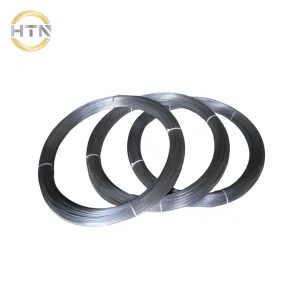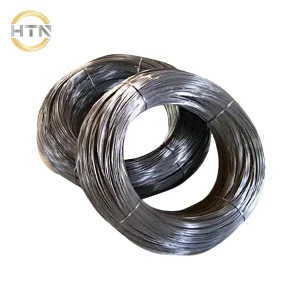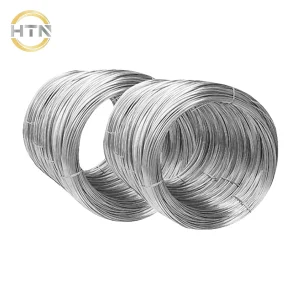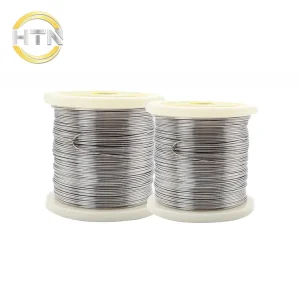






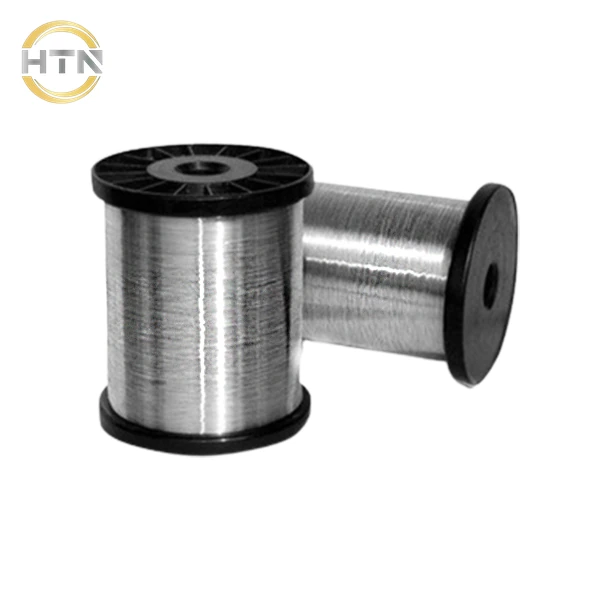
ASTM B863 Grade 5 Titanium Wire
- Standard: ASTM B863
- Grade: Grade 5 (Ti-6Al-4V Titanium Alloy)
- UNS: R56400
- Supply form: Coil, spool or straight cut length
- Condition: Annealed or cold-worked, as ordered
- Diameter Range: Ø0.03–Ø7.0 mm
Customizable sizes are available, while specific product parameters should be confirmed per the applicable standard edition and order.
Product Overview
ASTM B863 Grade 5 titanium wire is Ti-6Al-4V alpha-beta titanium-alloy wire with UNS designation R56400. Grade 5 is one of the most widely used titanium alloys. Aluminum stabilizes the alpha phase and vanadium stabilizes the beta phase. It combines high specific strength, good fatigue performance, intermediate fracture toughness, corrosion resistance and weldability. Final properties depend on chemistry, melt quality, thermomechanical history, microstructure, diameter, cold reduction and heat-treatment condition.
Compared with commercially pure Grade 4, Grade 5 provides substantially higher strength but generally lower room-temperature formability and greater sensitivity to notches, surface damage, processing heat and high-temperature contamination. Grade 5 wire may be used for high-strength fasteners, lock wire, spring-like or formed parts and aerospace components. Filler, medical or flight-critical uses require the applicable AWS, medical, AMS or customer specification in addition to ASTM B863.
| Specification | Details | ||
| Industrial Standard | ASTM B863 | ||
| Grades | Gr5 | ||
| Diameter Range | Ø0.03–Ø7.0 mm | ||
| Typical Diameters | Ø0.1, 0.2, 0.3, 0.4, 0.5, 0.6, 0.8, 1.0, 1.2, 1.5, 2.0, 2.5, 3.0, 4.0, 5.0, 6.0, 7.0 mm | ||
| Supply Form | Coil / Spool or straightened and cut wire |
Grade-equivalence note: Grade 5 is commonly called TC4 in the Chinese market. ASTM Grade 5 and Chinese GB/T grades must be certified to their own specifications and should not be declared fully equivalent without a clause-by-clause comparison.
Main Characteristics
- High specific strength: Annealed Ti-6Al-4V is substantially stronger than commercially pure titanium while its density is only about 4.42-4.43 g/cm³, making it useful where both weight and load capacity matter.
- Good fatigue and general engineering performance: With controlled microstructure, surface condition and residual stress, the alloy can provide good fatigue performance; design allowables must come from the applicable specification and validated data.
- Corrosion resistance with low density: It resists general corrosion in seawater, humid atmosphere and many chloride environments, but this does not establish immunity in every crevice, reducing acid or hot-salt condition.
- Weldable with strict shielding: Qualified fusion-welding methods may be used, with complete inert-gas protection of the weld and hot heat-affected zone and strict prevention of oxygen, nitrogen, hydrogen, carbon and iron contamination.
- Useful low-temperature properties: Ti-6Al-4V retains useful strength and toughness at low temperature. Fracture-critical service may require Grade 23 ELI or another specified material and must not substitute Grade 5 by name alone.
- Heat-treatable: Unlike commercially pure titanium, Grade 5 can be strengthened and its microstructure modified by solution treatment and aging. Annealed, stress-relieved and solution-treated-and-aged conditions are not interchangeable and the ordered condition must be explicit.
Chemical Composition
The following limits apply to ASTM B863 Grade 5. Values are mass percentages. Formal acceptance is governed by the contract edition and the producer’s certified report.
| Element | ASTM B863 Grade 5 requirement |
| Aluminum, Al | 5.5-6.75% |
| Vanadium, V | 3.5-4.5% |
| Nitrogen, N | ≤0.05% |
| Carbon, C | ≤0.08% |
| Hydrogen, H | ≤0.015% |
| Iron, Fe | ≤0.40% |
| Oxygen, O | ≤0.20% |
| Residual elements, each | ≤0.10% |
| Residual elements, total | ≤0.40% |
| Titanium, Ti | Balance |
Technical references: ASTM B863 grade scope, TIMETAL 6-4, and ATI Ti-6Al-4V Grade 5 technical data.
- Aluminum and vanadium: Aluminum stabilizes alpha and contributes strength; vanadium stabilizes beta and enables microstructure and properties to be controlled by thermomechanical processing and heat treatment.
- Oxygen, nitrogen, iron and carbon: Affect strength, hardness, toughness and processability. Excess content or high-temperature contamination can reduce ductility and notch performance.
- Hydrogen: Must be strictly controlled. Improper pickling, heat treatment or electrochemical exposure can promote hydrogen pickup and hydride risk.
- Titanium content: ASTM states Titanium: Balance. Ti-6Al-4V is a nominal alloy name; acceptance follows each specified elemental range and titanium by difference, not a separate guarantee such as ‘approximately 90% Ti.’
Mechanical Properties
ASTM B863 includes tensile, elongation and hardness requirements for Grade 5 wire. Properties vary with diameter and delivery condition. Formal acceptance must therefore follow the ordered annealed or cold-worked condition, applicable size range, test method and the official tables of the specified standard edition.
| Property | Product-page technical statement | Acceptance basis |
| Tensile strength | Depends on diameter and annealed/cold-worked condition | Applicable ASTM B863 table and purchase order |
| Elongation | Depends on diameter, gauge length and condition | Applicable ASTM B863 table and purchase order |
| Hardness | The specification includes applicable requirements; one value cannot cover every condition | Applicable grade, condition and test method |
| Yield strength | Minimum values defined for annealed condition(Rp0.2≥795 MPa); cold‑worked values vary with cold reduction & wire diameter, no universal fixed value | Specify condition, diameter and acceptance requirements in purchase order if yield strength is required |
Typical Annealed Grade 5 Properties (TIMETAL 6‑4 reference data, NOT ASTM B863‑26 wire guaranteed acceptance values)
| Property | Typical annealed Ti-6Al-4V value |
| Ultimate tensile strength | Approx. 950 MPa |
| 0.2% yield strength | Approx. 880 MPa |
| Elongation | Approx. 14% |
| Reduction of area | Approx. 36% |
Important: The values above are representative annealed Grade 5 data and are not ASTM B863 wire acceptance values. Diameter, cold reduction and final annealing materially affect strength, elongation and hardness. Quotations, contracts and MTRs should identify diameter, tolerance, condition, surface, coil weight or cut length, and inspection requirements.
HTN Supply and Quality Documentation
HTN organizes the supply of ASTM B863 Grade 5 titanium-alloy wire according to customer purchase requirements. Material is produced by qualified titanium-mill resources. Original mill test reports, heat traceability, chemistry and performance records can be supplied as agreed. HTN reviews the standard edition, heat number, documents, diameter, tolerance, delivery and heat-treatment condition, surface, coil weight or cut length, and can arrange independent retesting, cut-to-length service, clean packaging and third-party inspection when required.
Typical Applications
- Aerospace lock wire, tie wire, fastener stock and small high-strength structural parts;
- high-strength connectors, pins, retaining rings, clips and drawing-defined formed parts;
- spring-like, coiled and precision wire components requiring a high strength-to-weight ratio;
- corrosion-resistant high-strength connection or locating parts for marine, chemical and energy equipment;
- lightweight parts for motorsport, bicycles, sporting goods and high-performance consumer products;
- critical components only when the applicable aerospace, medical or customer material specification is also satisfied;
- welding filler wire when AWS A5.16 ERTi-5 or another applicable consumable specification is met;
- high-strength wire parts made to customer drawings and validated by forming, fatigue or functional testing.
Application boundary: ASTM B863 compliance alone does not make Grade 5 wire implant grade, aerospace grade or qualified welding filler. Medical, aerospace or filler-wire uses may additionally require ASTM F1472, ASTM F136/ISO 5832-3 when Grade 23 ELI is specified, AMS, AWS A5.16 ERTi-5, customer material specifications, drawings and the appropriate quality system.
Fill in the form below and our team will be happy to assist you
Fabrication and Machining Characteristics
Drawing and Dimensional Control
Grade 5 has high strength, low thermal conductivity, pronounced elastic recovery and a tendency to adhere to dies. Drawing requires rigid equipment, clean well-maintained tooling, suitable lubrication, controlled area reduction and scheduled intermediate anneals to manage diameter, roundness, surface damage, microstructure and residual stress.
Cold working
Cold drawing further increases strength and hardness but reduces ductility and increases springback. Fine-wire properties are especially sensitive to final reduction, diameter, surface defects and heat treatment. Subsequent coiling, bending or flattening requirements should be stated at inquiry stage.
Annealing and heat treatment
Annealing develops the ordered microstructure, restores some ductility and reduces residual stress. Grade 5 may also be solution treated and aged, but temperature, soak, cooling rate and section size strongly affect alpha-beta microstructure and properties. A qualified procedure is required; generic temperatures are not purchase guarantees.
Welding and joining
GTAW/TIG, laser welding, resistance welding or another qualified method may be used. The weld pool, root and hot heat-affected zone require complete inert-gas shielding. If supplied as filler wire, AWS A5.16 ERTi-5 or the customer consumable specification, cleanliness and procedure qualification must be confirmed separately; ASTM B863 compliance alone does not qualify welding wire.
Typical Physical Properties
The following are typical reference values for annealed Ti-6Al-4V near room temperature and are not mandatory lot-acceptance requirements of ASTM B863 .
| Physical property | Typical value |
| Density | Approx. 4.42-4.43 g/cm³ |
| Elastic modulus | Approx. 107-122 GPa |
| Thermal conductivity at 20°C | Approx. 6.6-6.7 W/(m·K) |
| Electrical resistivity near 0-20°C | Approx. 1.68-1.78 μΩ·m |
| Mean CTE, 0-100°C | Approx. 9.0×10⁻⁶/K |
| Mean CTE, 20-425°C | Approx. 9.4×10⁻⁶/K |
| Specific heat at 20°C | Approx. 0.58 kJ/(kg·K) |
| Beta transus | Typically approx. 980-1000°C |
| Melting range | Approx. 1604-1660°C |
| Magnetism | Essentially non-magnetic |
Physical-property references: TIMETAL 6-4 and ATI Ti-6Al-4V Grade 5 technical data. Values vary with heat, temperature, orientation, microstructure and heat-treatment condition.
Corrosion Resistance
Grade 5 wire obtains good general corrosion resistance from a stable titanium-oxide passive film and commonly performs well in seawater, humid atmosphere and many neutral chloride environments. High strength does not imply universally superior corrosion resistance; crevices, deposits, stress, temperature, dissimilar-metal contact and hydrogen-charging conditions must be evaluated.
Environments in Which Grade 5 Generally Performs Well
- Seawater, salt spray and humid air;
- neutral chloride and brine solutions;
- many oxidizing acid environments;
- nitric acid and some oxidizer-containing process streams;
- many organic acids and organic compounds;
- alkaline media;
- wet chlorine and hydrated halogen environments;
- many food, pharmaceutical and high-purity-water systems.
Environments Requiring Careful Evaluation
- Strong reducing acids under oxygen-starved conditions;
- hot concentrated hydrochloric or sulfuric acid;
- fluoride-containing media or hydrofluoric acid;
- tight crevices in hot concentrated chloride or sulfate solutions;
- anhydrous methanol or halide-contaminated methanol;
- red fuming nitric acid;
- molten chloride salts;
- cathodic-protection or electrochemical conditions that may promote hydrogen absorption;
- dissimilar-metal contact with an unsuitable galvanic design.
Engineering caution: Grade 5 is not immune to every corrosive environment. Fine wire and mesh may also be affected by crevices, deposits, contacting metals and cleaning residues. Evaluate crevice corrosion in hot chloride service and control hydrogen pickup during pickling, heat treatment and electrochemical use.
Typical Industry Manufacturing Route for Grade 5 Titanium Wire
- Raw-material selection and charge preparation: Select qualified titanium sponge, aluminum-vanadium master alloy and controlled clean revert; accurately control aluminum and vanadium together with oxygen, iron, nitrogen, hydrogen and other impurities.
- Electrode preparation: Homogenize and compact the charge and weld a consumable electrode while controlling segregation and excluding iron particles, oil, moisture and foreign contamination.
- Vacuum melting and ingot production: VAR is commonly used and may be combined with qualified remelting or cold-hearth routes to improve homogeneity and cleanliness. ASTM B863 does not prescribe one identical melt count for every Grade 5 wire order; any special requirement belongs in the purchase order.
- Ingot conditioning and breakdown: Crop unsuitable ends, remove surface defects, and forge or roll to break down the cast structure and produce billet or rod suitable for wire processing.
- Hot processing to wire rod: Forge, roll or process coil in a qualified alpha-beta or other controlled temperature range, managing temperature, reduction, grain size and alpha-beta microstructure while avoiding overheating and excessive alpha case.
- Surface conditioning and multi-pass drawing: Remove scale and alpha case, inspect and remove laps, cracks and other defects, then draw through successive dies to final diameter with intermediate anneals as needed.
- Intermediate and final heat treatment: Apply a qualified anneal, stress relief or agreed strengthened condition, controlling time, temperature, atmosphere and cooling to obtain the specified structure and properties.
- Surface finishing: Use pickling, mechanical cleaning, polishing or another approved method while controlling hydrogen pickup, oxidation, alpha case, iron contamination and surface notches.
- Straightening, coiling and cutting: Supply on coils or spools, or as straight cut lengths, and inspect diameter, roundness, straightness of cut lengths, coil quality and surface condition.
- Inspection and traceability: Verify chemistry, tensile properties, elongation, hardness, dimensions and surface quality, maintaining traceability from heat and lot to spool or package and material-test documentation.
Melting and inspection note: ASTM B863 requires finished wire to meet applicable chemistry, performance, dimensional and quality requirements. It does not prescribe the same number of VAR melts for every Grade 5 product. Double or triple VAR, tight roundness, special roughness, cleanliness, nondestructive testing, EN 10204 3.1 documentation and third-party inspection must be confirmed in the purchase order when required.