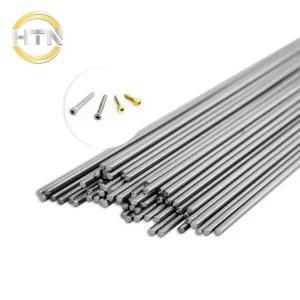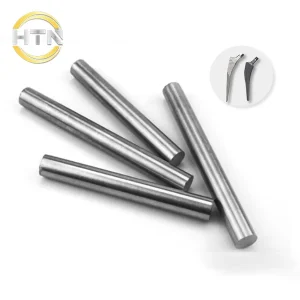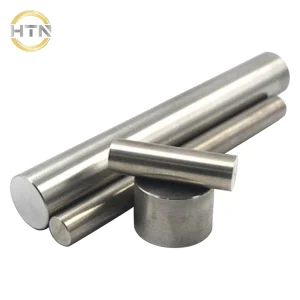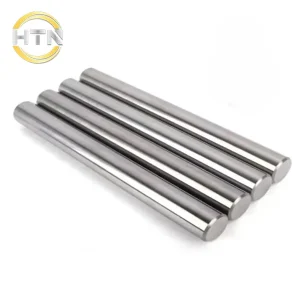






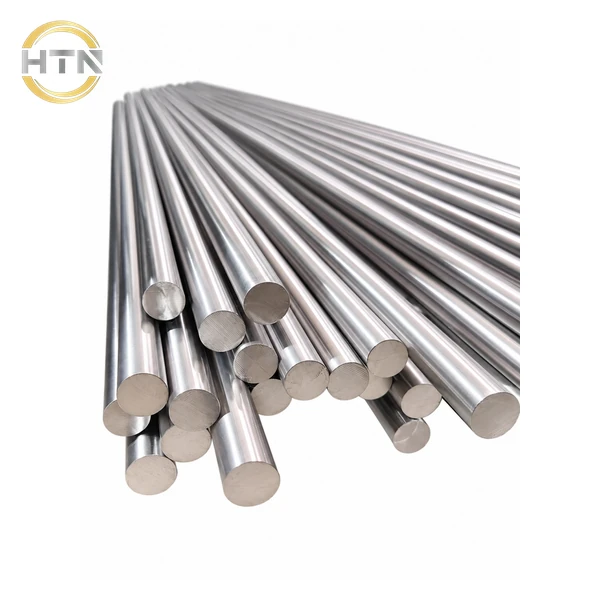
Barre de titane de grade 12 conforme à la norme ASTM B348
- Standard: ASTM B348
- Grade: Grade 12
- Type de matériau : Ti-0.3Mo-0.8Ni near-alpha titanium alloy
- ONU : R53400
- Structure à température ambiante : Typical near-alpha microstructure, predominantly alpha
- Condition: recuit
- Dia: φ7 ~ φ300 mm
- Longueur typique des barres industrielles : 200–3000 mm
Des tailles personnalisables sont disponibles, mais les paramètres spécifiques du produit doivent être confirmés conformément à l'édition standard et à la commande applicables.
Présentation du produit
ASTM B348 Grade 12 titanium rod/bar is a Ti-0.3Mo-0.8Ni near-alpha titanium alloy bar produced and tested to ASTM B348/B348M. The alloy is UNS R53400, with 0.20% to 0.40% molybdenum and 0.60% to 0.90% nickel. Its room-temperature microstructure is predominantly alpha with a limited beta phase fraction.
Compared with commercially pure Grade 2, Grade 12 offers higher strength and improved corrosion performance in selected oxidizing-to-mildly-reducing, chloride-brine and crevice conditions. It is commonly supplied annealed and is selected for long-term corrosion reliability, weldability and pressure-equipment applications. Formal acceptance shall follow the contract edition, condition, dimensions and supplementary requirements.
Grade 12 bar is suitable for chemical-process reactors and internals, heat-exchanger components, pumps, valves, flanges, fasteners, seawater and brine-system hardware, hydrometallurgical equipment, flue-gas-desulfurization equipment and corrosion-critical machined components in energy, marine and oil-and-gas service.
| Spécification | Détails |
| Norme industrielle | ASTM B348 |
| Qualités industrielles | Gr12 |
| Plage de diamètres | Ø7 – Ø300 mm |
| Diamètres typiques | Ø7, 8, 10, 12, 14, 16, 18, 20, 25, 30, 35, 40, 45, 50, 60, 70, 80, 90, 100, 120, 150, 200 mm |
| Longueur typique des barres industrielles | 200 à 3 000 mm ; possibilité de découpe à longueur. |
| État de surface / d'approvisionnement | Surface noire laminée à chaud / Tournée / Rectifiée |
| Tolérance de précision | h6 / h7 / h8 disponibles sous réserve de diamètre, de finition et de confirmation de commande |
Caractéristiques principales
- Enhanced crevice-corrosion resistance: Molybdenum and nickel improve corrosion stability in selected oxidizing-to-mildly-reducing, chloride-brine and hot-brine duties. Actual suitability must be verified for the service environment.
- Higher strength than Grade 2: Annealed ASTM minimum tensile strength is 483 MPa, minimum 0.2% offset yield strength is 345 MPa and minimum elongation is 18%.
- Bonne soudabilité : TIG, MIG, plasma, laser and electron-beam welding may be used with complete high-purity inert-gas shielding of the weld pool, face, root and hot heat-affected zone.
- Good cold and hot workability: The alloy can be forged, hot rolled, drawn, turned, milled, drilled, ground, bent and stamped. Complex cold forming must be qualified for bend radius, surface condition and intermediate annealing.
- Faible densité et comportement essentiellement non magnétique : Sa densité est d'environ 4,51 g/cm³, ce qui permet la fabrication d'équipements légers résistants à la corrosion et certaines applications sensibles à la réponse magnétique.
- Not principally heat-treat strengthened: Grade 12 is a near-alpha titanium alloy. Annealing stabilizes microstructure, relieves stress and supports fabrication; special thermal conditions must be stated in the order and validated by an approved process.
Composition chimique
ASTM B348 Grade 12 chemistry is controlled to the following mass-percent limits:
| Élément | ASTM B348 Grade 12 requirement |
| Azote, N | ≤0,030% |
| Carbone, C | ≤0,080% |
| Hydrogène, H | ≤0,015% |
| Fer, Fe | ≤0,300% |
| Oxygène, O | ≤0,250% |
| Molybdenum, Mo | 0.20%–0.40% |
| Nickel, Ni | 0.60%–0.90% |
| Éléments résiduels, chacun | ≤0,100% |
| Éléments résiduels, total | ≤0,400% |
- Molybdenum and nickel are the defining alloying elements. Their controlled addition supports corrosion performance in designated chloride, hot-brine and mildly reducing environments.
- Oxygen, nitrogen, carbon, hydrogen and iron must be controlled. Oxygen, nitrogen and carbon can increase strength while reducing ductility; excessive hydrogen can form brittle hydrides and raise embrittlement risk.
- Final chemistry shall be confirmed by the original mill test report for the applicable heat. Any more-stringent drawing, NACE, ASME, ASTM B265/B338/B861 or customer requirement must be stated in the order.
Exigences mécaniques
The following room-temperature tensile requirements apply to annealed ASTM B348 Grade 12 bar. The specified edition, dimensions, specimen form and test orientation must also be considered for formal acceptance.
| Propriété | Exigence | Statut |
| Résistance à la traction ultime, Rm | ≥483 MPa | ASTM minimum |
| 0,2% limite d'élasticité décalée, Rp0,2 | ≥345 MPa | ASTM minimum |
| Allongement dans la longueur de jauge spécifiée | ≥18% | ASTM minimum |
| Réduction de surface, Z | ≥25% | ASTM minimum |
Propriétés typiques à température ambiante (non garanties)
| Propriété | Valeur de référence |
| résistance à la traction ultime | Approx. 483–620 MPa |
| limite d'élasticité décalée de 0,2% | Approx. 345–483 MPa |
| Élongation | Approx. 18–30% |
| Réduction de la surface | Generally not less than 25% |
| module d'élasticité | Approx. 103–105 GPa |
Important: Typical values are not ASTM acceptance values and are not automatically guaranteed for every lot. Hardness, UT, PMI, microstructure, corrosion testing, NACE or other tests must be ordered when required.
Services d'approvisionnement et de qualité HTN
ASTM B348 Grade 12 titanium bar is produced by evaluated, qualified mill resources. HTN confirms technical requirements from customer drawings and purchase specifications, selects a mill with appropriate capability, reviews the original MTR and heat/lot records, and verifies the relationship among material standard, dimensions, quantity, condition and inspection documents.
Lorsque cela est convenu dans le contrat, HTN peut coordonner les tests indépendants, l'examen par ultrasons, le PMI, le service de coupe à longueur, le tournage ou le meulage, la documentation EN 10204 3.1 et l'inspection par un tiers, ainsi que l'emballage pour l'exportation, les documents d'expédition et la livraison internationale.
Applications typiques
- Chemical-process reactors, vessels, agitators, tower internals and corrosion-resistant machined components;
- Heat exchangers, condensers, evaporators, seawater and brine heat-transfer-system components;
- Pump shafts, valve stems, valves, flanges, fasteners and pressure-equipment parts;
- Desalination, marine engineering, shipboard, hydrometallurgical, energy and oil-and-gas equipment;
- Flue-gas desulfurization, pollution control and other chloride-bearing or mildly reducing wet-process systems;
- Custom engineering parts requiring weldability, low weight and an improved margin against crevice corrosion.
Remplissez le formulaire ci-dessous et notre équipe se fera un plaisir de vous aider.
Caractéristiques de fabrication et de traitement
Usinage
Grade 12 can be turned, milled, drilled, ground and threaded. Titanium’s relatively low thermal conductivity, elastic recovery and tendency to gall call for sharp rigid tooling, stable feed, appropriate cutting speed and abundant non-chlorinated cutting fluid. Dwell and rubbing should be avoided.
formage à froid
Its room-temperature forming latitude is generally close to Grade 2 and it can be bent, stamped, drawn and spun. Complex or tight-radius shapes should be validated by trial or qualified procedure, using staged forming, intermediate annealing or warm forming when needed.
Travail à chaud et traitement thermique
Hot forging, rolling, extrusion and drawing can be used to produce bar. Working temperature, reduction, soak time, cooling path and atmosphere must follow a qualified process to limit grain coarsening, oxidation and alpha case. Annealing stabilizes microstructure and properties and supports the required strength-ductility balance.
Soudage
Grade 12 has good weldability. The weld pool, face, root and hot heat-affected zone require complete high-purity inert-gas shielding. Critical weldments should be qualified for joint strength, ductility, corrosion behavior and any required post-weld treatment.
Sécurité d'usinage : Les fines particules et poudres de titane sont combustibles et doivent être collectées, stockées et manipulées à l'écart des sources d'inflammation, conformément aux exigences de sécurité applicables.
Propriétés physiques typiques
Les valeurs suivantes sont des valeurs de référence typiques proches de la température ambiante et ne constituent pas des exigences d'acceptation de lot obligatoires selon la norme ASTM B348 :
| propriété physique | valeur typique |
| Densité | Environ 4,51 g/cm³ |
| module d'élasticité | Approx. 103–105 GPa |
| Chaleur spécifique à température ambiante | Environ 0,52 J/(g·K) |
| conductivité thermique | Approx. 15–17 W/(m·K) |
| résistivité électrique | Approx. 0.56–0.60 μΩ·m |
| CTE moyen, 20–100 °C | Approx. 8.8–9.2×10⁻⁶/K |
| Beta transus | Approx. 875–905°C |
| température de fusion | Environ 1660–1670°C |
| Coefficient de Poisson | Environ 0,34 |
| Magnétisme | Généralement considérés comme non magnétiques |
Physical-property references: public Grade 12 technical data and industry data. Values vary with temperature, heat, orientation, section size and annealed condition.
résistance à la corrosion
Grade 12 corrosion resistance is based on a continuous, tightly adherent titanium-oxide passive film. Molybdenum and nickel improve titanium’s behavior in selected oxidizing-to-mildly-reducing, chloride-brine and crevice conditions, giving Grade 12 a higher crevice-corrosion margin than Grade 2. Actual material selection must still be verified against medium, temperature, concentration, oxygen availability, flow and crevice conditions.
Environments in Which Grade 12 Generally Performs Well
- Eau de mer naturelle, atmosphères marines, embruns salés, saumures et de nombreux milieux aqueux à forte teneur en chlorures ;
- nombreuses solutions aqueuses neutres, eau industrielle générale, dessalement et services de transfert de chaleur applicables ;
- acide nitrique et de nombreux environnements acides oxydants ;
- evaluated mildly reducing-acid, hot-brine and chloride-bearing aqueous duties;
- wet-process metallurgy, chemical processing, pollution control, energy, marine and oil-and-gas systems demanding improved crevice-corrosion resistance.
Environnements nécessitant une évaluation minutieuse
- Milieux contenant du fluorure ou acide fluorhydrique ;
- acides chauds, concentrés, pauvres en oxygène ou fortement corrosifs contenant des ions métalliques réducteurs ;
- chlore complètement sec, méthanol anhydre ou méthanol contaminé par des halogénures ;
- acide nitrique fumant rouge, sels de chlorure fondus, mercure liquide, cadmium et autres environnements chimiques spéciaux ;
- pickling, cathodic protection or electrochemical conditions that may promote hydrogen pickup;
- crevasses chaudes, dépôts, contacts entre métaux dissemblables et zones de contrainte.
Avertissement technique : Molybdenum and nickel improve the corrosion margin but do not make Grade 12 universally suitable for all acids, halides or oxygen-starved media. Product literature cannot replace actual-service corrosion testing and engineering review.
Typical Production Process for Grade 12 Titanium Rod
- Raw-material and alloying preparation: Select qualified titanium sponge, molybdenum and nickel addition materials and approved clean revert, while controlling oxygen, nitrogen, carbon, hydrogen, iron and foreign contamination.
- Préparation des électrodes : Compact the charge into electrode blocks and assemble the melting electrode, ensuring uniform molybdenum and nickel distribution and exclusion of oil, moisture and iron-bearing foreign matter.
- Fusion sous vide et production de lingots : Use VAR, electron-beam cold-hearth melting or another approved titanium melting route. The melting route and number of melts follow the qualified mill process and purchase requirements.
- Conditionnement et chimie des lingots : Récolter, éplucher ou broyer selon les besoins, effectuer les analyses chimiques requises, conserver l'identification thermique et réaliser les contrôles de qualité internes nécessaires.
- Forgeage par décomposition : Upset, draw or multi-directionally forge to break down the cast structure, improve internal uniformity and produce billet for further working.
- Alpha/near-beta hot working and bar formation: Forge, hot roll, extrude, draw or combine processes to produce the required section, controlling temperature, reduction and cooling path for a stable near-alpha microstructure.
- Annealing: Anneal under a qualified procedure to stabilize microstructure, relieve stress and obtain the required strength-ductility balance.
- Surface conditioning, straightening and finishing: Turn, grind, blast, pickle, straighten, cut, chamfer or polish as required. Pickling must limit hydrogen pickup and meet surface-quality requirements.
- Final inspection, documentation and delivery: Verify chemistry, tensile properties, dimensions, tolerances, surface and identification. UT, PMI, microstructure, hardness, corrosion tests or third-party inspection are performed when ordered. Maintain full correlation among material, labels, heat, lot, condition and original MTR.