






In the field of metal materials, titanium and titanium alloys stand out for their unique properties and are widely used in numerous industries such as aerospace, medical devices, and chemicals. The passivation process, as a key technology for enhancing the performance and durability of titanium alloys, plays an indispensable role. The progress of this important process has also attracted continuous attention and reporting from the industry information platform “Titanium Home,” providing timely and comprehensive information for professionals both inside and outside the industry.
The Basic Concept of Passivation and the Natural Advantages of Titanium Alloys
Passivation refers to the process of treating a metal with a strong oxidizing agent or through electrochemical methods to render its surface inactive. The goal is to transform the metal surface into a state that is not easily oxidized, thereby slowing down the corrosion rate of the metal. Additionally, when the chemical activity of an active metal or alloy is greatly reduced to a state resembling that of a noble metal, this phenomenon is also called passivation.
Titanium and titanium alloys exhibit exceptionally outstanding passivation performance, thanks to their ability to rapidly form an oxide film on their surface, with a thickness ranging from a few nanometers to several tens of nanometers. This natural oxide film acts like a sturdy “armor,” endowing titanium alloys with excellent corrosion resistance, enabling them to maintain stable performance in various harsh environments.
Common Passivation Processes for Titanium Alloys
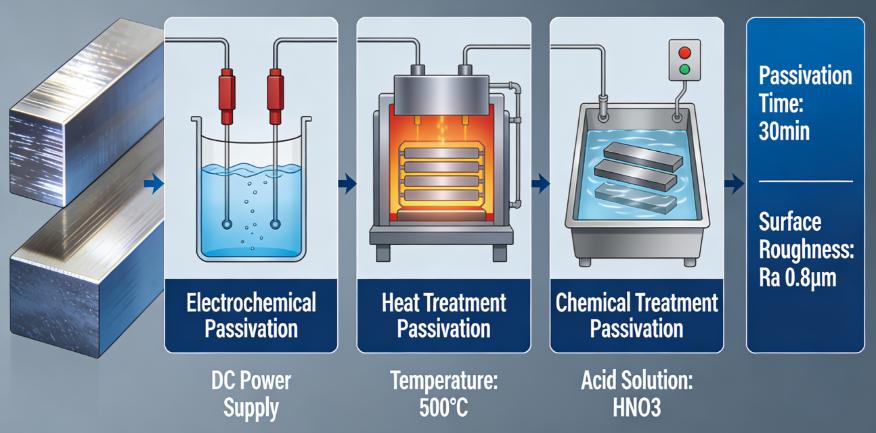
Electrochemical Passivation
Electrochemical passivation utilizes electrochemical principles to form a dense oxide film on the surface of the titanium alloy. This oxide film acts as a tight防线 (defensive line), effectively preventing the titanium alloy from corrosion in chemical media and also avoiding scratches during processing. Electrochemical passivation mainly includes two methods: anodic oxidation and cathodic reduction. Among these, anodic oxidation is the most widely used method for titanium and titanium alloy products.
Taking common titanium products such as titanium cups and titanium chopsticks as examples, the anodic oxidation method can form a very thin (colorless and transparent) oxide film on their surface. When light shines on this oxide film, refraction occurs, and oxide films of different thicknesses cause the human eye to perceive different colors. The thickness of the oxide film starts from the thinnest 0.01μm and gradually increases in increments of 0.01μm, up to a maximum of 0.15μm. It is this variation in thickness that allows pure titanium metal products to display rich and vivid colors, which is why titanium is known as a dreamlike metal material.
Heat Treatment Passivation
Heat treatment passivation involves placing the titanium alloy in a heated furnace and subjecting its surface to oxidation treatment under specific time and temperature conditions. After forming an oxide layer of a certain thickness, rapid quenching is carried out to form a dense oxide film. This oxide film can significantly increase the corrosion resistance of the titanium alloy, allowing it to maintain good performance even in harsh chemical environments. For example, in some chemical equipment, titanium alloy components that have undergone heat treatment passivation can operate stably for long periods, reducing equipment maintenance and replacement costs.
Chemical Passivation
Chemical passivation includes two steps: pickling and chemical passivation. Pickling is a common method used in the processing of titanium and titanium alloys. Its main function is to remove oil stains, oxide films, and impurities from the titanium alloy surface, creating favorable conditions for subsequent chemical passivation. Chemical passivation involves treating the titanium alloy surface in a solution containing specific chemical substances, causing a dense oxide film to form on the surface, thereby stabilizing the surface condition and improving the durability and corrosion resistance of the titanium alloy.
Detailed Process and Precautions for the Pickling Passivation Process
Pre-treatment
Before pickling and passivation, if there are contaminants such as dirt on the surface of the titanium alloy, they should first be removed by mechanical cleaning methods, followed by degreasing and de-oiling treatment. This step is crucial because surface dirt and oil can affect the effectiveness of pickling and passivation, leading to uneven formation of the oxide film, thereby reducing the corrosion resistance of the titanium alloy.
Process Control
In pickling and passivation operations, process control is key. Generally, a nitric acid solution (HNO₃) is used for pickling. Based on experience, the ratio of nitric acid to water is typically 1:10 or 1:15. If the ratio is improper or the operation is incorrect, the operation tank will release a large amount of “yellow smoke.” “Yellow smoke” not only pollutes the environment but also poses hazards to human health. Therefore, the ratio of the nitric acid solution and operating conditions must be strictly controlled during the process.
Pickling Time
Under otherwise constant conditions, the longer the pickling time, the more thorough the reaction, and theoretically, the better the pickling effect. However, titanium has a strong affinity for hydrogen. If the pickling time is too long, the amount of hydrogen absorbed by the titanium will gradually increase. The ingress of hydrogen can reduce the toughness of the titanium alloy, causing hydrogen embrittlement, which seriously affects the performance of the titanium alloy. Therefore, in the pickling process, 5 to 10 minutes is a more suitable time range.
Post-treatment
After pickling is complete, water washing is necessary to remove residual pickling solution and impurities. The water washing must be thorough to ensure that no acidic substances remain on the titanium alloy surface; otherwise, it will affect the subsequent chemical passivation effect and the quality of the oxide film. After water washing, drying treatment is also required to remove surface moisture, preventing residual moisture from causing rust or other corrosion phenomena on the titanium alloy surface again.
Safety and Environmental Protection
During the pickling and passivation process, great attention must be paid to the use and disposal of acidic solutions. Acidic solutions are highly corrosive. If leaked or improperly disposed of, they can cause serious environmental pollution and also harm the human body. Therefore, operators must strictly adhere to safety operating procedures and wear protective equipment such as protective gloves, goggles, and protective clothing. At the same time, acidic solutions must be properly treated to ensure compliance with environmental requirements.
Conclusion
The titanium alloy passivation process is a commonly used surface treatment technology. It can effectively remove oxides, corrosion products, and other impurities from the surface of titanium alloys, improving the surface quality and material properties of titanium alloys. Through the application of different methods such as electrochemical passivation, heat treatment passivation, and chemical passivation, as well as strict control and operation of the pickling passivation process, titanium alloys can maintain good performance in various harsh environments, extending their service life and providing strong support for the development of various industries. With the continuous advancement of technology, the titanium alloy passivation process will also be constantly improved and innovated, opening up even broader prospects for the application of titanium alloys.