






Titanium alloys present a series of special challenges during forging due to their high deformation resistance and active chemical properties. First, the microstructure and properties of titanium alloy forgings are highly sensitive to forging thermal parameters. Their forging temperature range is relatively narrow, and as the deformation rate increases, the deformation resistance rises significantly, exhibiting strong strain rate sensitivity. Second, titanium alloys have poor thermal conductivity, making them prone to localized overheating during forging, which creates large internal and external temperature differences, further exacerbating the uneven distribution of deformation between the core and surface of the billet, leading to cracking or even product rejection. Therefore, studying the effects of different forging processes on the microstructure and mechanical properties of titanium alloys and seeking reasonable forming processes are of great practical significance for production.
Gr5 titanium alloy is currently the most widely used α+β dual-phase titanium alloy. Thanks to its excellent properties, it has been extensively applied in aerospace, automotive, medical, and other fields. Researchers worldwide have conducted numerous studies on its various properties and processing techniques. However, systematic comparisons of the effects of different forging processes on the microstructure and mechanical properties of Gr5 titanium alloy are rarely reported. To address this gap, researchers selected three typical processes—β forging, near-β forging, and (α+β) dual-phase forging—and studied their effects on the microstructure and mechanical properties of Gr5 titanium alloy bars, aiming to identify the optimal forging solution and provide a reference for producing Gr5 titanium alloy forgings that meet requirements.
I. Experimental Materials and Methods
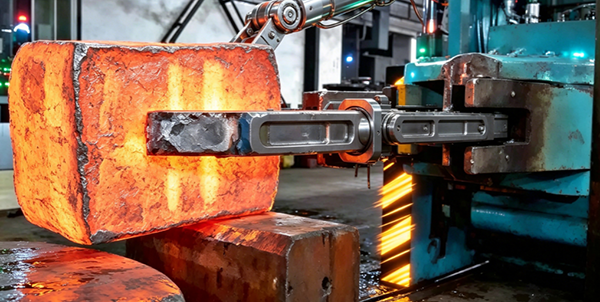
The experiment used Gr5 titanium alloy forging billets with dimensions of Φ100mm × 450mm. The (α+β)/β phase transition temperature (Tβ) was determined to be 990°C using the metallographic method. The forging billet was divided into three equal sections, and three forging process tests were conducted on each section, all with a deformation amount of 50%. The forging equipment was a 3t free-forging hammer:
Conventional (α+β) forging: Tβ – 60°C
Near-β forging: Tβ – 20°C
β forging: Tβ + 40°C
After forging, all forgings were subjected to dual heat treatment: 900°C × 1h/AC + 600°C × 4h/AC. After heat treatment, metallographic samples, tensile samples, and impact samples were taken. Microstructures were observed under a metallographic microscope, and quantitative statistics such as equiaxed α phase content and secondary lamellar α phase thickness were measured using image analysis software.
II. Experimental Results and Analysis
1.Microstructure Characteristics
After forging with the three different processes, Gr5 titanium alloy exhibited significantly different microstructures:
α+β forging: Equiaxed microstructure
Near-β forging: Mixed microstructure (equiaxed α + lamellar β)
β forging: Lamellar microstructure
2.Mechanical Properties Comparison
Strength: The strengths of the bars processed under the three processes were comparable, with no significant differences.
Plasticity: The plasticity of α+β forging and near-β forging was significantly higher than that of β forging.
Impact toughness: β forging exhibited the best impact toughness, superior to the other two processes.
Overall, the Gr5 titanium alloy bars after near-β forging demonstrated the best comprehensive mechanical properties (good balance of strength, plasticity, and impact toughness).
3.Fracture Morphology
The tensile specimen fractures under all three forging processes exhibited a ductile fracture mechanism. The specific differences are as follows:
α+β forging and near-β forging: Fractures showed relatively deep and uniformly distributed equiaxed dimples.
β forging: Fractures displayed relatively flat and elongated dimples.
III. Conclusions
1.After α+β forging, near-β forging, and β forging, Gr5 titanium alloy respectively exhibits equiaxed microstructure, mixed microstructure, and lamellar microstructure.
2.The strengths of the bars under the three processes are comparable. The plasticity of α+β forging and near-β forging is higher than that of β forging, but β forging has the best impact toughness.
3.Near-β forging achieves the best comprehensive mechanical properties and is a relatively optimized forging process solution for Gr5 titanium alloy bars.
4.The tensile fractures of all three processes are ductile fractures, but there are significant differences in dimple morphology: α+β forging and near-β forging present uniform equiaxed dimples, while β forging presents flat elongated dimples.
This study provides a clear reference basis for selecting forging processes in the actual production of Gr5 titanium alloy forgings. Particularly when strength, plasticity, and impact toughness need to be balanced, near-β forging is a solution worth prioritizing.