






I. Introduction
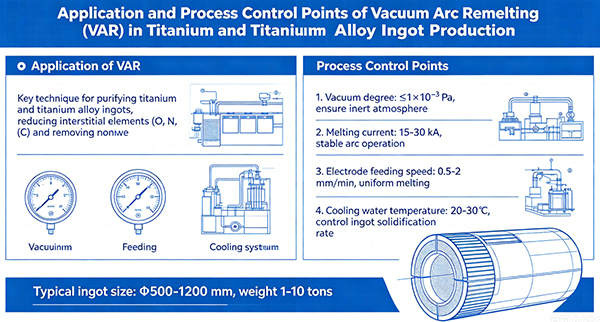
Vacuum Arc Remelting (VAR) is still one of the most widely adopted melting technologies for the production of titanium and titanium alloy ingots. Because titanium exhibits strong chemical activity at high temperatures, especially its affinity for oxygen, nitrogen, and hydrogen, conventional melting methods are unable to effectively prevent contamination and quality deterioration. VAR technology, by carrying out the melting process under vacuum conditions, provides a stable and clean metallurgical environment that ensures the production of high-quality titanium alloy materials.
This process offers the following advantages:
1.Prevents contamination of titanium and its alloys by harmful gases such as oxygen, nitrogen, and hydrogen from the atmosphere.
2.Provides favorable thermodynamic and kinetic conditions for the purification of metallic materials.
3.The sequential solidification and melting method facilitates the flotation of non-volatile insoluble impurities and improves the ingot structure.
4.Allows hot topping for shrinkage compensation, improving the yield.
In addition, the VAR process helps improve the chemical homogeneity of titanium alloy ingots, reduces macrosegregation, and enhances the internal compactness of the material. Due to these characteristics, VAR technology is widely used in the production of titanium materials for aerospace, chemical engineering, marine equipment, biomedical devices, and other high-end industrial applications where strict quality requirements are imposed on the alloy structure and performance.
Based on these advantages, VAR has become an economical and effective means of producing titanium and titanium alloy ingots and remains an indispensable process in the titanium industry.
II. Melting Quality and Key Process Parameters
The melting quality of titanium and titanium alloy ingots directly affects subsequent processing performance, including forging, rolling, extrusion, heat treatment, and the final mechanical properties of the material. Therefore, maintaining stable operating conditions during the VAR process is of great importance.
In a VAR furnace, the following parameters are key to ensuring stable melting and improving ingot quality:
Vacuum level and leak rate inside the furnace
Melting voltage
Melting current
Cooling water outlet temperature and flow rate at the crucible
These process parameters are closely interrelated and together determine the stability of the electric arc, the shape and depth of the molten pool, the solidification behavior of the ingot, and the overall metallurgical quality of the final product. During the melting process, fluctuations in voltage or current can easily cause arc instability, which may further result in abnormal solidification structures, segregation defects, or surface quality problems.
The vacuum level inside the furnace is particularly important because titanium alloys are highly sensitive to atmospheric contamination during high-temperature melting. A stable high-vacuum environment not only minimizes gas absorption but also promotes the removal of volatile impurities and residual gases from the molten metal. In actual production, excessive furnace leakage may lead to increased gas content, unstable arc behavior, and deterioration of ingot quality. Therefore, leak rate control is often considered more critical than simply increasing pumping speed.
Melting voltage and current are the core electrical parameters of the VAR process. The voltage mainly affects the arc length and melting stability, while the current determines the melting rate and heat input. Appropriate matching of voltage and current is essential for achieving a stable molten pool and smooth solidification. Excessive current may deepen the molten pool and increase the risk of segregation, whereas insufficient current may reduce melting efficiency and lead to unstable melting conditions.
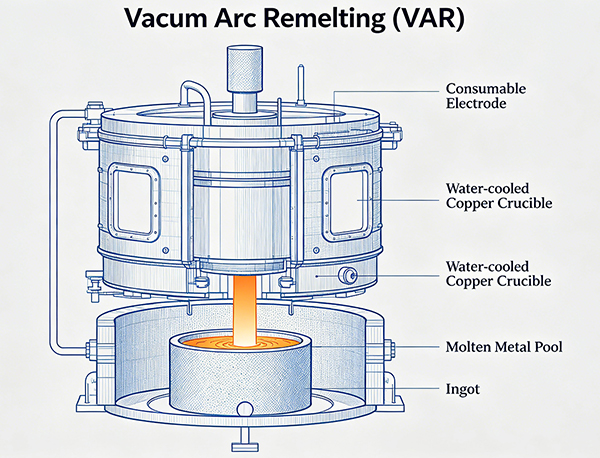
The cooling condition of the water-cooled copper crucible is another key factor influencing ingot quality. The cooling system controls the solidification rate of the molten metal and directly affects ingot surface quality, grain structure, and shell formation. Insufficient cooling may cause local overheating or even burn-through accidents, while excessive cooling may generate large thermal stresses and increase the possibility of surface cracking.
Based on years of experience in titanium and titanium alloy melting, researchers have analyzed the control requirements of the melting process on voltage and current. On this basis, a melting control technique aimed at achieving “calm melting” is described for reference by relevant engineers and technicians. Calm melting refers to maintaining a stable arc condition, uniform heat input, and smooth molten pool behavior throughout the entire remelting process, thereby reducing splashing, segregation, and internal defects while improving ingot quality and process stability.
III. Research Conclusions on Key Process Control Points
The research concludes that:
(1) Design of the vacuum degassing system – The design and selection of the vacuum degassing system should first consider the conventional gas content carried by the self-consuming electrode compacted from titanium sponge, residual impurity elements from the titanium sponge production method, and the main components removed by volatilization during melting. Production efficiency and manufacturing costs should also be taken into account. When using VAR for titanium and titanium alloys, more attention should be paid to the leak rate of the furnace chamber rather than the pumping speed alone. A stable vacuum environment is essential for reducing gas contamination and ensuring metallurgical cleanliness. Therefore, the sealing performance of the furnace body, pipelines, and vacuum valves must be strictly controlled during both equipment design and daily operation.
(2) Crucible cooling system – The crucible cooling system forms the main environment for ingot solidification and growth and is also a very important and critical factor for ingot surface quality and melting safety. During the melting process, the cooling intensity directly affects the shape of the molten pool and the solidification structure of the ingot. Uniform and stable cooling conditions help maintain a proper shell thickness and reduce the occurrence of surface cracks, segregation, and local overheating. At the same time, reliable monitoring of cooling water flow rate, pressure, and outlet temperature is necessary to prevent accidents caused by insufficient cooling capacity.
(3) Electrode drive mechanism – The electrode drive mechanism is the actuator that maintains a constant melting voltage. To ensure rapid response, its flexibility must be guaranteed. Since the electrode continuously melts during VAR operation, the electrode feeding system must adjust the electrode position in real time according to voltage fluctuations. A highly sensitive and stable drive mechanism is beneficial for maintaining arc stability and achieving calm melting. Poor response performance may lead to arc interruption, short circuits, or unstable heat input, thereby negatively affecting ingot quality.
(4) Power supply and furnace layout – The relative spatial layout of the melting power supply and the furnace should be reasonably arranged to shorten the short-network impedance of the furnace and reduce the voltage drop in the current transmission loop. An optimized electrical layout can improve power transmission efficiency, reduce energy loss, and stabilize arc operation. Excessive circuit impedance may cause current fluctuation and unstable melting conditions, which are unfavorable for obtaining a uniform ingot structure. Therefore, the arrangement of transformers, busbars, and electrical connections should be carefully designed during equipment installation.
(5) Grounding system – A proper grounding method and a good grounding system are basic conditions for ensuring the reliable operation of the VAR furnace electrical system. Effective grounding can reduce electromagnetic interference, stabilize control signals, and improve operational safety. Poor grounding conditions may not only affect instrument accuracy and automatic control performance but may also lead to electrical hazards and equipment malfunction. Consequently, the grounding resistance and integrity of the grounding network should be regularly inspected and maintained during production.
In addition to the above factors, the quality of the consumable electrode itself also has a significant influence on the melting process. Electrode density uniformity, welding quality, and surface cleanliness all directly affect arc stability and melting consistency. Defects in the electrode may lead to abnormal arc behavior, splashing, inclusion defects, and local segregation within the ingot.
Furthermore, with the continuous development of titanium alloy production technology, modern VAR furnaces are increasingly equipped with advanced automatic control systems, real-time monitoring technology, and digital data acquisition systems. These technologies enable more precise control of melting parameters and improve process stability, production efficiency, and product consistency.
IV. Conclusion
As the core technology for the production of titanium and titanium alloy ingots, the process control level of VAR directly affects product quality, structural uniformity, and production efficiency. By optimizing key aspects such as vacuum level, cooling system, electrode drive, power supply layout, and grounding, the goal of “calm melting” can be achieved, further improving ingot quality and yield.
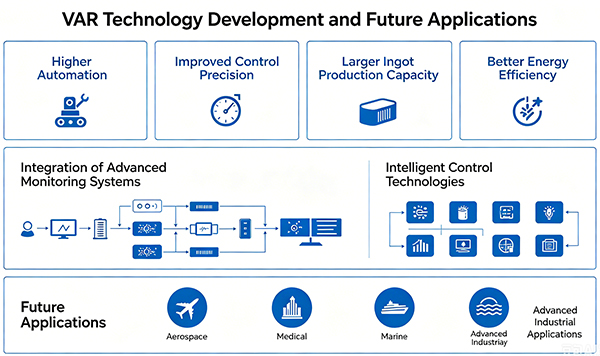
At present, VAR technology continues to develop toward higher automation, improved control precision, larger ingot production capacity, and better energy efficiency. Through the integration of advanced monitoring systems and intelligent control technologies, the stability and reliability of the melting process can be further enhanced. In the future, VAR will continue to play a crucial role in the production of high-performance titanium and titanium alloy materials for aerospace, medical, marine, and other advanced industrial applications.