






- Classification by Chemical Composition
Based on the content and type of alloying elements in titanium, it is divided into two major categories: commercially pure titanium and titanium alloys. This is the primary basis for grade selection in production.
1.1 Commercially Pure Titanium (Industrial Pure Titanium)
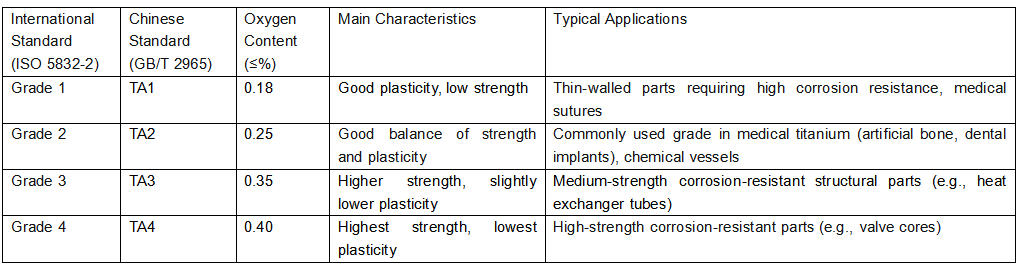
Contains only trace impurities (such as Fe, C, N, O, H) with no deliberately added alloying elements. It offers good plasticity, excellent corrosion resistance, and moderate strength, making it suitable for components that do not require high strength but demand high corrosion resistance (e.g., joint prosthesis substrates in medical implants, chemical piping).
It is classified into multiple grades based on oxygen content (which affects strength and plasticity). The correspondence between international standards (ISO) and Chinese standards (GB/T) is as follows:
1.2 Titanium Alloys (Classified by Main Alloying Elements)
By adding elements such as Al, V, Mo, Zr, and Nb, the strength, heat resistance, corrosion resistance, or biocompatibility are improved. These are commonly used in high-end fields (aviation, medical). Based on alloying element types, they are divided into four major systems:
(1) α-type Titanium Alloys (Stable at low temperatures, excellent corrosion resistance)
- Alloying elements: Mainly α-stabilizers (e.g., Al, Sn, Zr), with no or only a small amount of β-stabilizers.
- Characteristics: α single-phase structure at room temperature; good weldability; corrosion resistance close to that of pure titanium; higher strength than pure titanium, but low high-temperature strength (≤500°C).
- Typical grades:
- Grade 5 (Ti-6Al-4V ELI): Commonly used in medical titanium alloys (ELI = Extra Low Interstitial, with lower C/O/N content and better biocompatibility); used for artificial joints and spinal fixation devices.
- Grade 9 (Ti-3Al-2.5V): High strength and high plasticity; used for aviation tubing and medical interventional devices (e.g., stents).
- Grade 23 (Ti-6Al-4V ELI): Further reduced interstitial elements compared to Grade 5; suitable for long-term implantable components.
(2) β-type Titanium Alloys (Stable at high temperatures, high strength) - Alloying elements: Mainly β-stabilizers (e.g., Mo, Nb, Ta, V) in relatively high amounts (≥10%).
- Characteristics: Can obtain β single-phase or α+β dual-phase structure through quenching/aging treatment at room temperature; high strength (tensile strength ≥1100 MPa); good cold workability; good biocompatibility (non-toxic elements).
- Typical grades (medical-related):
- Ti-13Nb-13Zr: V- and Al-free, avoiding toxicity from metal ion release; used for dental implants and artificial joints.
- Ti-29Nb-13Ta-4.6Zr (TNZT alloy): Elastic modulus close to human bone (approx. 60 GPa, lower than Ti-6Al-4V’s 110 GPa), reducing the “stress shielding” effect; a promising direction for medical titanium alloys.
- Ti-15Mo: Strong corrosion resistance; used for chemical corrosion-resistant parts and medical orthopedic instruments.
(3) α+β-type Titanium Alloys (Balanced overall performance) - Alloying elements: Contain both α-stabilizers (Al) and β-stabilizers (V, Mo).
- Characteristics: α+β dual-phase structure at room temperature; properties can be adjusted via heat treatment (annealing, solution aging) to balance strength (higher than α alloys), plasticity (better than β alloys), and high-temperature performance (≤600°C); widely used in aerospace and medical fields.
- Typical grades:
- TC4 (Grade 5, Ti-6Al-4V): Non-ELI version; used for aviation structural parts (airframes, wings), engine fan/compressor mid-low temperature sections, biological implants, and naval components.
- Grade 22 (Ti-6Al-4V ELI): Higher purity than Grade 5 ELI; used for demanding medical implants.
- Ti-6Al-2Sn-4Zr-2Mo: High-temperature strength superior to Ti-6Al-4V; used for aviation engine blades (≤550°C).
(4) Near-α-type Titanium Alloys (Excellent high-temperature strength) - Alloying elements: Mainly α-stabilizers with a small amount of β-stabilizers (≤2%).
- Characteristics: Structure predominantly α-phase with a small amount of β-phase; high high-temperature strength (≤650°C) and good oxidation resistance; suitable for high-temperature environments.
- Typical grades:
- Ti-8Al-1Mo-1V: Used for aviation engine combustion chambers and high-temperature fasteners.
- Ti-6Al-2Sn-4Zr-6Mo: High high-temperature strength; used for aerospace vehicle components.
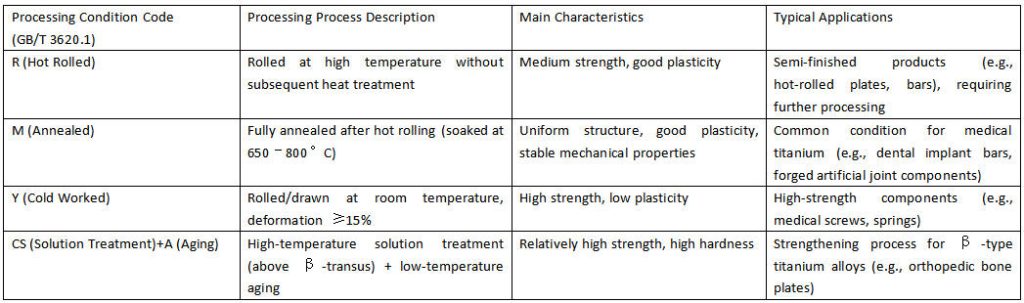
2.Classification by Processing Condition
For the same titanium grade, mechanical properties (strength, plasticity) vary significantly depending on rolling, forging, and heat treatment processes. This must be clearly indicated in production. Common processing conditions are as follows:
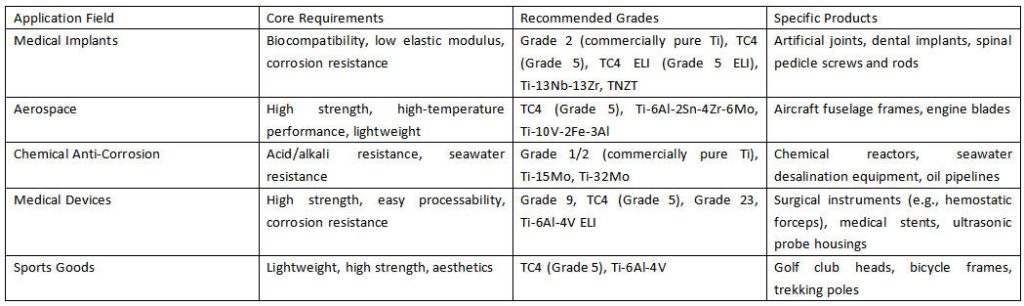
3.Classification by Application Field
Different fields have significantly different performance requirements for titanium materials. The following shows grade matching for core application areas:
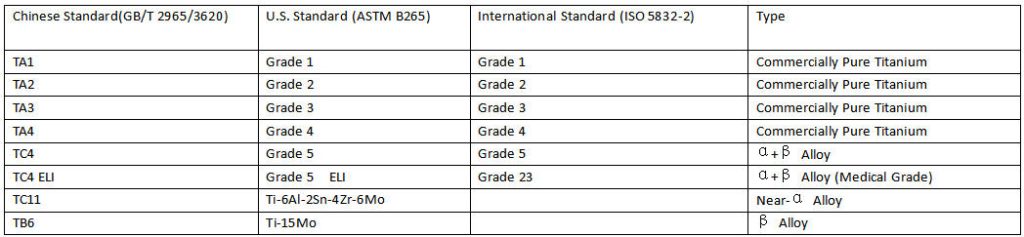
4.Grade Cross-Reference Table
In production, it is often necessary to coordinate international orders (e.g., ASTM, ISO standards) with domestic procurement (GB standards). The cross-reference for core grades is shown below:
5.Special Requirements for Medical Titanium Grades
For the production of medical titanium materials, the following two points require special attention:
- Interstitial Element Control: Medical grades (e.g., Grade 5 ELI, TNZT) require C ≤ 0.08%, O ≤ 0.13%, N ≤ 0.05%, H ≤ 0.015%, which are stricter than industrial grades. Strict control must be exercised during the melting stage (vacuum arc remelting).
- Biocompatibility Certification:** Must pass ISO 10993-1 (Biological evaluation of medical devices) testing to ensure no cytotoxicity and no sensitization. Grade selection must comply with YY/T 0640 (Medical titanium and titanium alloy wrought materials) standards.