





Introduction
The global titanium industry has experienced remarkable growth over the past decade, driven by increasing demand from aerospace, medical, chemical processing, and marine sectors. As a leading titanium manufacturer, Shaanxi Huatainuo Metal Co., Ltd. has established itself as a trusted supplier of high-quality titanium products, serving diverse industrial applications with precision-engineered materials that meet stringent international standards.
According to Grand View Research, the global titanium market size was valued at $24.7 billion in 2023 and is projected to reach $35.5 billion by 2030, growing at a compound annual growth rate (CAGR) of 5.3%. This growth trajectory underscores the critical role that titanium manufacturers play in supplying materials for advanced technological applications, from medical implants to aerospace components.
Understanding Titanium Manufacturing Excellence
Core Competencies of Premium Titanium Producers
Modern titanium manufacturing requires sophisticated capabilities across multiple dimensions. A reputable titanium bar manufacturer must demonstrate expertise in:
Material Processing: Advanced melting techniques including Vacuum Arc Remelting (VAR) and Electron Beam Cold Hearth Remelting (EBCHR), achieving purity levels exceeding 99.7% titanium content. These processes eliminate inclusions and ensure consistent material properties, critical for safety-critical applications in aerospace and medical devices.
Quality Control Systems: Implementation of Statistical Process Control (SPC) with sampling frequencies of 100% for critical parameters. Dimensional tolerances for titanium bars typically range from ±0.001 inches (0.025 mm) for precision applications to ±0.005 inches (0.127 mm) for standard industrial uses.
Certification Compliance: Adherence to international standards including ASTM B348 (titanium and titanium alloy bars and billets), ASTM F136 (wrought titanium-6aluminum-4vanadium eli alloy for surgical implants), and AMS (Aerospace Material Specifications) requirements.
Manufacturing Process Overview
The titanium manufacturing process encompasses several critical stages:
1. Sponge Production: The Kroll process reduces titanium tetrachloride (TiCl4) with magnesium at temperatures of 800-850°C, producing titanium sponge with purity levels of 99.5-99.7%. Global sponge production capacity exceeds 200,000 metric tons annually, with major producers located in China, Japan, and Russia.
2. Melting and Casting: Vacuum Arc Remelting (VAR) consumes 15-20 kWh per kilogram of titanium, producing ingots weighing 5-15 metric tons. Multiple remelting passes (typically 2-3) ensure homogeneous composition and eliminate segregation.
3. Primary Fabrication: Hot working operations including forging and rolling reduce ingots to intermediate forms (billets, bars, plates) at temperatures of 800-950°C, with deformation rates carefully controlled to prevent surface defects and maintain grain structure integrity.
4. Secondary Processing: Cold working, machining, and surface treatment operations achieve final dimensions and surface finishes, with roughness values (Ra) ranging from 0.8-3.2 μm for standard applications to 0.1-0.4 μm for polished medical implants.
Product Portfolio and Specifications
Titanium Bar Products
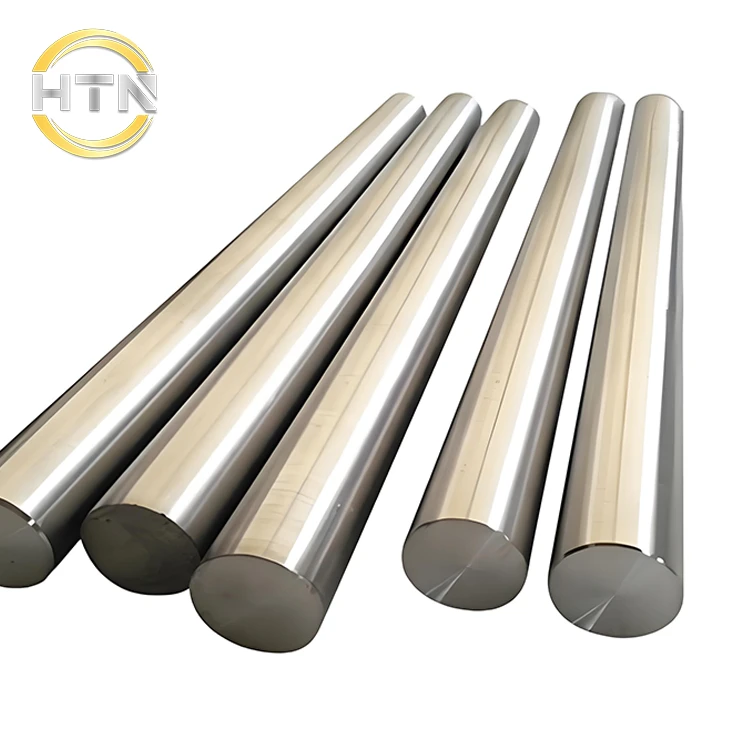
Titanium bars represent a fundamental product category, serving as raw material for subsequent machining operations or as finished components in structural applications. Key specifications include:
Commercially Pure (CP) Titanium Grades:
– Grade 1 (ASTM B348): Ultimate tensile strength 240-310 MPa, elongation 24-30%
– Grade 2 (ASTM B348): Ultimate tensile strength 345-450 MPa, elongation 18-25%
– Grade 3 (ASTM B348): Ultimate tensile strength 450-550 MPa, elongation 14-20%
Titanium Alloys:
– Ti-6Al-4V (Grade 5): Ultimate tensile strength 895-950 MPa, yield strength 825-880 MPa, elongation 10-14%
– Ti-6Al-4V ELI (Grade 23): Ultimate tensile strength 860-900 MPa, elongation 10-15%, reduced interstitial content for improved ductility
The ASTM F136 titanium bar specification represents the gold standard for medical implant applications, requiring:
– Aluminum content: 5.5-6.5%
– Vanadium content: 3.5-4.5%
– Interstitial elements: O ≤ 0.13%, N ≤ 0.013%, C ≤ 0.08%, H ≤ 0.012%
– Ultimate tensile strength: minimum 860 MPa
– Yield strength: minimum 795 MPa
– Elongation: minimum 10%
Dimensional Capabilities
Titanium manufacturers offer comprehensive dimensional ranges:
| Product Form | Diameter/Thickness Range | Length Range | Tolerance |
|————–|————————-|————–|———–|
| Round Bars | 3-300 mm | 100-6000 mm | h9-h11 |
| Square Bars | 10-100 mm | 100-3000 mm | ±0.1-0.5 mm |
| Hexagonal Bars | 10-80 mm | 100-3000 mm | ±0.1-0.5 mm |
| Flat Bars | 5-50 mm × 20-200 mm | 100-3000 mm | ±0.1-0.5 mm |
Industrial Applications
Medical and Healthcare Sector
Titanium’s biocompatibility makes it the material of choice for medical implants and surgical instruments:
Orthopedic Implants: Hip and knee replacements utilize Ti-6Al-4V ELI alloy, with over 2 million procedures performed annually in the United States alone. The material’s modulus of elasticity (110 GPa) more closely matches human bone (10-30 GPa) compared to stainless steel (200 GPa), reducing stress shielding effects and improving long-term implant stability.
Dental Implants: Titanium dental implants achieve osseointegration rates exceeding 95% over 10-year periods, with surface treatments including sandblasting, acid etching, and anodization enhancing bone-implant contact. Global dental implant market size reached $4.5 billion in 2023, with titanium implants representing over 85% of the market.
Surgical Instruments: Titanium instruments offer advantages including 40% weight reduction compared to stainless steel, non-magnetic properties for MRI compatibility, and superior corrosion resistance in sterilization environments involving steam autoclaving at 134°C.
Aerospace Industry
Aerospace applications demand materials combining high strength-to-weight ratios with exceptional fatigue resistance:
Airframe Components: Titanium alloys comprise 15-20% of modern commercial aircraft structural weight, including landing gear components, wing spars, and engine pylon structures. The Boeing 787 Dreamliner utilizes approximately 136 metric tons of titanium per aircraft, representing 15% of total structural weight.
Engine Components: Jet engine applications include compressor blades, discs, and casings operating at temperatures up to 600°C. Titanium’s specific strength (strength-to-density ratio) of 260 kN·m/kg exceeds aluminum (170 kN·m/kg) and approaches steel (260 kN·m/kg) at 40% of steel’s density.
Fasteners and Hardware: Titanium fasteners reduce weight by 40% compared to steel equivalents while maintaining equivalent strength, with typical applications requiring 10,000-50,000 fasteners per aircraft.
Chemical Processing Industry
Titanium’s exceptional corrosion resistance enables demanding chemical processing applications:
Heat Exchangers: Titanium tube bundles withstand corrosive media including chlorides, sulfates, and organic acids, with service lives exceeding 20 years in seawater cooling applications. Heat transfer coefficients of 3000-5000 W/(m²·K) achieve efficient thermal performance.
Pressure Vessels: ASME Boiler and Pressure Vessel Code Section VIII permits titanium construction for vessels operating at pressures up to 3000 psi (20.7 MPa) and temperatures up to 300°C, with design margins of 3.5 on ultimate tensile strength.
Piping Systems: Titanium piping handles aggressive process streams including chlorinated hydrocarbons, nitric acid, and wet chlorine gas, with corrosion rates below 0.025 mm/year in most environments.
Quality Assurance and Testing
Material Testing Protocols
Comprehensive testing ensures material integrity and compliance with specifications:
Chemical Analysis: Optical Emission Spectroscopy (OES) and X-Ray Fluorescence (XRF) provide rapid elemental analysis with accuracy of ±0.01% for major alloying elements. Combustion analysis determines interstitial elements (O, N, C, H) with sensitivity of 10 ppm.
Mechanical Testing: Tensile testing per ASTM E8 determines yield strength, ultimate tensile strength, and elongation, with testing frequencies of one test per heat lot (typically 5000-10000 kg). Charpy impact testing evaluates toughness at temperatures ranging from -196°C to +200°C.
Non-Destructive Testing: Ultrasonic testing per ASTM E2375 detects internal defects with minimum detectable flaw size of 0.5 mm diameter. Surface inspection methods including liquid penetrant testing (PT) and eddy current testing (ET) identify surface-breaking defects.
Traceability Systems
Modern titanium manufacturers implement comprehensive traceability:
– Heat Lot Identification: Unique identifiers track material from sponge production through final fabrication
– Test Certificate Documentation: EN 10204 3.1/3.2 certificates provide complete material history
– Batch Segregation: Physical separation prevents material mixing and ensures specification compliance
Industry Standards and Specifications
International Standards Framework
Titanium manufacturers must navigate complex standards ecosystems:
ASTM International:
– ASTM B348: Standard Specification for Titanium and Titanium Alloy Bars and Billets
– ASTM F136: Standard Specification for Wrought Titanium-6Aluminum-4Vanadium ELI Alloy for Surgical Implant Applications
– ASTM F67: Standard Specification for Unalloyed Titanium for Surgical Implant Applications
International Organization for Standardization:
– ISO 5832-2: Implants for surgery – Metallic materials – Part 2: Unalloyed titanium
– ISO 5832-3: Implants for surgery – Metallic materials – Part 3: Titanium-6Aluminum-4Vanadium alloy
Aerospace Specifications:
– AMS 4928: Titanium Alloy Bars, Forgings, and Rings
– AMS 4967: Titanium Alloy Bars and Forgings
Supply Chain Considerations
Global Titanium Supply Dynamics
The titanium supply chain exhibits unique characteristics:
Raw Material Concentration: Titanium sponge production concentrates in China (60% global capacity), Japan (20%), and Russia (15%), creating geographic dependencies and supply chain risks. Strategic stockpiling by aerospace primes typically covers 6-12 months of consumption.
Lead Time Considerations: Standard titanium bar products require 4-8 weeks lead time, while specialty alloys and custom dimensions may require 12-20 weeks. Emergency sourcing capabilities and safety stock policies mitigate supply disruption risks.
Price Volatility: Titanium sponge prices exhibit significant volatility, ranging from $6-12 per kilogram over economic cycles. Long-term supply agreements with price adjustment mechanisms provide cost stability for major consumers.
Future Trends and Innovations
Advanced Manufacturing Technologies
Emerging technologies promise to transform titanium manufacturing:
Additive Manufacturing: Powder bed fusion processes enable complex geometries impossible through conventional fabrication, with build rates of 5-20 cm³/hour for titanium alloys. Aerospace applications increasingly adopt additive manufacturing for weight-critical components, with market growth exceeding 25% annually.
Advanced Melting Technologies: Plasma Arc Melting (PAM) and Induction Skull Melting (ISM) offer alternatives to conventional VAR, potentially improving yield by 5-10% while reducing energy consumption by 15-20%.
Surface Engineering: Advanced surface treatments including micro-arc oxidation (MAO) and plasma electrolytic oxidation (PEO) enhance wear resistance and biocompatibility, extending component service life by 2-5 times in demanding applications.
Conclusion
The titanium manufacturing industry continues to evolve, driven by advancing application requirements and technological innovations. As a premier titanium manufacturer, Shaanxi Huatainuo Metal Co., Ltd. exemplifies the capabilities required to serve demanding industrial sectors, combining advanced processing technologies, rigorous quality systems, and comprehensive product portfolios.
With titanium consumption projected to grow at 5-6% annually through 2030, manufacturers must continue investing in capacity expansion, process optimization, and quality enhancement to meet evolving customer requirements. The convergence of traditional metallurgical expertise with advanced manufacturing technologies positions the titanium industry for continued growth and innovation, supporting critical applications across medical, aerospace, chemical processing, and emerging sectors.
For engineers and procurement professionals seeking reliable titanium supply, partnership with qualified manufacturers offering comprehensive certifications, traceability systems, and technical support ensures successful application outcomes and long-term supply security.